 DongDong Park
Motion games in VR: from room-scale tracking to Beat Saber
Updated
VR (virtual reality) headsets changed how motion games look: the picture isn’t on a TV but fills your whole view. Turn your head and the scene turns; swing your hand and the controller follows. Three consumer headsets launched in 2016, standalone headsets stopped needing a computer in 2019, and since then the controllers can even be swapped for your bare hands.
Timeline
| When | Device or game | How it tracks |
|---|---|---|
| March 28, 2016 | Oculus Rift starts shipping | A sensor on the desk watches infrared LEDs on the headset |
| April 5, 2016 | HTC Vive starts shipping | Base stations sweep lasers; sensors on the devices time the sweeps |
| October 13, 2016 | PlayStation VR launches | A camera tracks 9 LEDs on the headset |
| December 2016 | Oculus Touch controllers | Sensors watch infrared LEDs on the controllers |
| May 1, 2018 | Beat Saber (Early Access) | Swing sabers to the music |
| May 21, 2019 | Oculus Quest standalone headset | Four cameras on the headset track “inside-out” |
| December 2019 | Quest hand tracking (experimental) | The cameras recognize bare hands |
| February 2024 | Apple Vision Pro | Eyes, hands and voice |
2016: three ways to track
- Oculus Rift (shipping from March 28, $599): a sensor on the desk watches a ring of infrared LEDs on the headset, which Oculus calls “Constellation” tracking. It first shipped to 20 countries and regions. Touch controllers followed in December.
- HTC Vive (shipping from April 5): made by HTC with Valve. Two “base stations” plugged into wall outlets sweep lasers across the room, and sensors on the headset and controllers time when each sweep passes them, which gives angles and position. Players can walk around in a space of at least about 6.5 by 5 feet (2 m × 1.5 m), which is called “room scale.”
- PlayStation VR (October 13, $399): connects to a PS4. The PlayStation Camera tracks 9 LEDs on the front, back and sides of the headset, and PS Move works as the controllers. Sony reports 5 million sold worldwide by the end of 2019.
2019: standalone headsets and inside-out tracking
Oculus Quest shipped on May 21, 2019, from $399. It needs no computer and no sensors placed around the room: according to Oculus, four ultra-wide cameras on the headset, together with inertial sensors, use computer-vision algorithms to track the headset’s own position in real time, and watch the infrared LEDs on the controllers to track the hands. This is called inside-out tracking.
In December that year Quest added hand tracking as an experimental feature: no controllers, the cameras recognize your hands and fingers directly. Motion games took another step from “holding a device” toward “just your body.”
Beat Saber: the best-known motion game in VR
Beat Games, an independent studio in Prague, Czech Republic, released Beat Saber in Early Access on Steam on May 1, 2018. You hold a light saber in each hand and slice the blocks flying at you to the music, while dodging walls with your body. The full version came out on May 21, 2019, and that November Facebook bought the studio. Oculus said in February 2021 that it had sold more than 4 million copies across platforms, plus more than 40 million paid songs.
2024: eyes, hands and voice
Apple announced Apple Vision Pro in June 2023 and released it in the US in February 2024. It has no controllers: according to Apple, you look at something to select it, tap your fingers together to confirm and flick your wrist to scroll, and its R1 chip processes input from 12 cameras, 5 sensors and 6 microphones.
Can kids play? How much space do you need?
- Headset makers all set a minimum age, commonly somewhere from 10 to 13 and up; check the manual. Younger kids are better off with motion games on a big screen, with no headset.
- In VR you can’t see the room, so clear the area completely. Meta recommends at least about 6.5 by 6.5 feet (2 m × 2 m) for moving around and 3.3 by 3.3 feet (1 m × 1 m) for stationary play; HTC asks for at least 6.5 by 5 feet (2 m × 1.5 m) for room scale (see How much space motion games need).
- Long sessions can cause dizziness and tired eyes, so keep each session short (see Are motion games bad for kids’ eyes?).
Camera games on a TV or projector need far less: about 6 by 6 feet (2 m × 2 m) of clear floor, and you can see the room the whole time. See Setup and Safety and privacy. How motion games, VR and AR differ is explained in Motion games, VR and AR.
Common questions
How do VR motion games track movement?
There are three approaches: an outside sensor or camera watches infrared LEDs on the headset (Oculus Rift, the PS VR camera); base stations on the wall sweep lasers and sensors on the devices time them (HTC Vive); or cameras on the headset look out at the room and the controllers “inside-out” (from Oculus Quest on), which later learned to recognize bare hands too.
How many copies has Beat Saber sold?
Oculus said in February 2021 that Beat Saber had sold more than 4 million copies across platforms, plus more than 40 million paid songs.
How much space do you need for VR?
Meta recommends at least about 6.5 by 6.5 feet (2 m × 2 m) of clear space for moving around with a Quest, and 3.3 by 3.3 feet (1 m × 1 m) for stationary play. HTC Vive’s room scale needs at least about 6.5 by 5 feet (2 m × 1.5 m).
More in “The history of motion games, from light guns to webcams”
- The history of motion games, from light guns to webcams (overview)
- What was the first motion game?
- Before the Wii: balance boards, mats, gloves and dance pads (1982–2004)
- EyeToy (2003): the camera comes to the living room
- The Wii (2006): motion controls for the whole family
- Kinect (2010): nothing to hold, and why it was discontinued
- PlayStation Move, Switch and Ring Fit: motion games turn to fitness
- Motion games in schools: from DDR in PE class to today
- Webcams and the browser: motion games without special hardware
- Why did motion gaming fade, and where did it go?
Games mentioned here
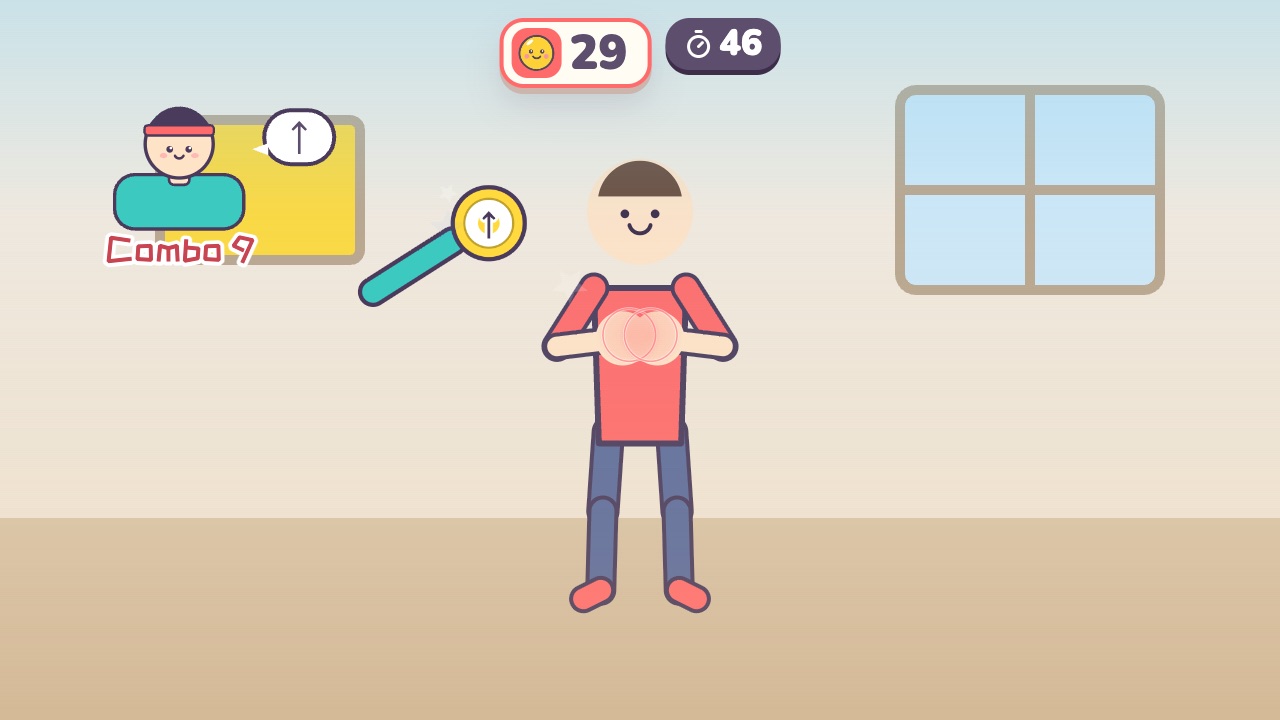 Boxing PracticeThe coach holds up pads: punch left, right and up, dodge the gloves and duck the barAges 9–18 · High activity · Hands / Fitness
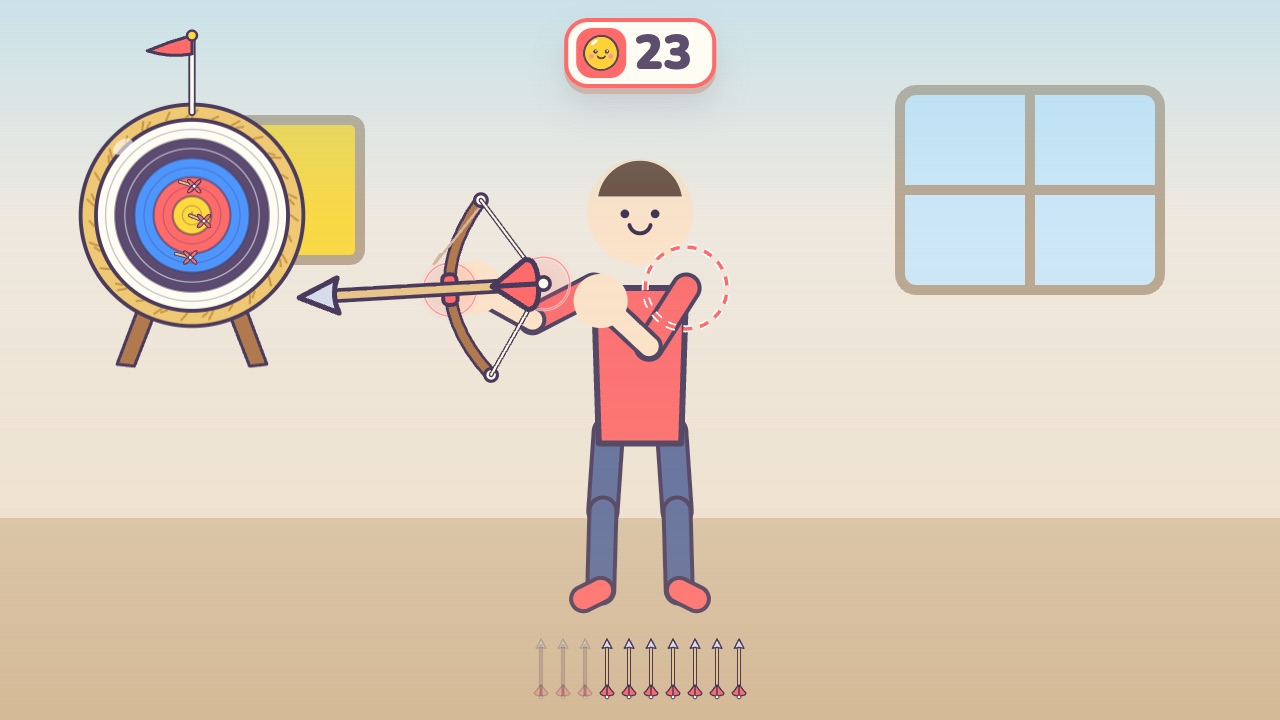 ArcheryOne arm is the bow, the other pulls the string. Hold steady, then let it flyAges 8–18 · Light activity · Hands / Calm
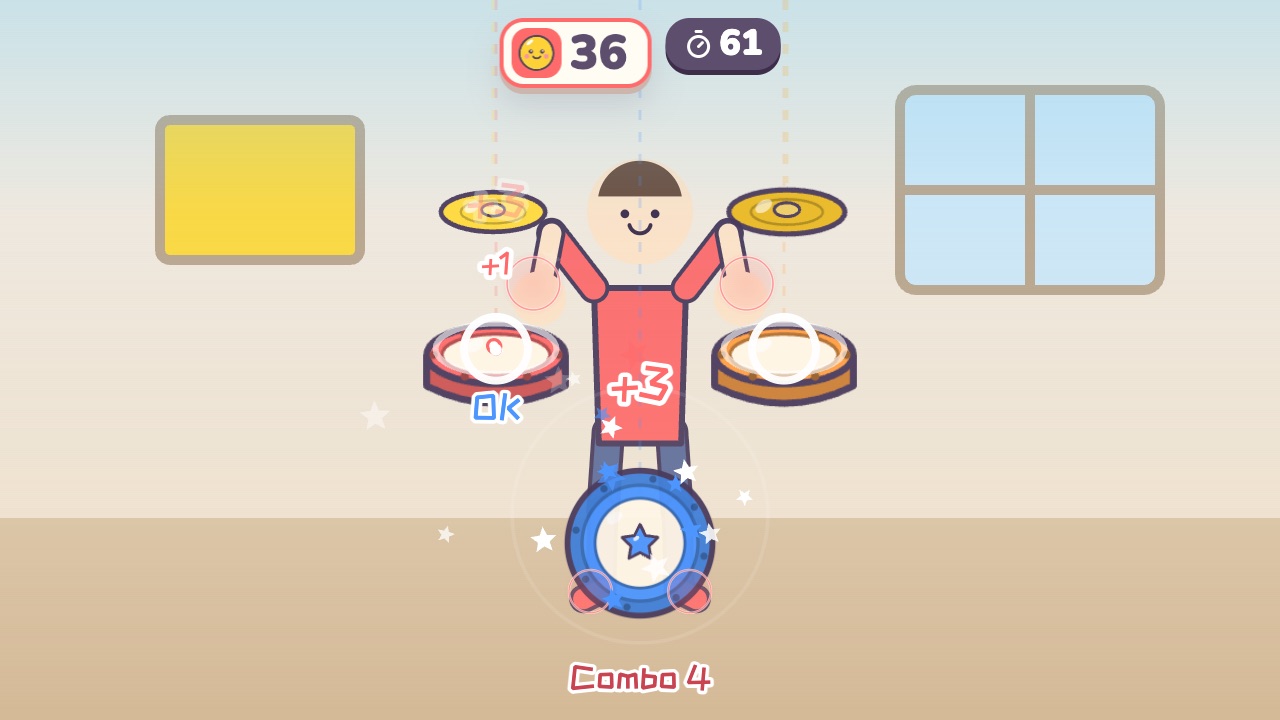 Air DrumsA drum kit floats around you. Hit the drums as the notes fallAges 6–18 · Moderate activity · Rhythm / Hands
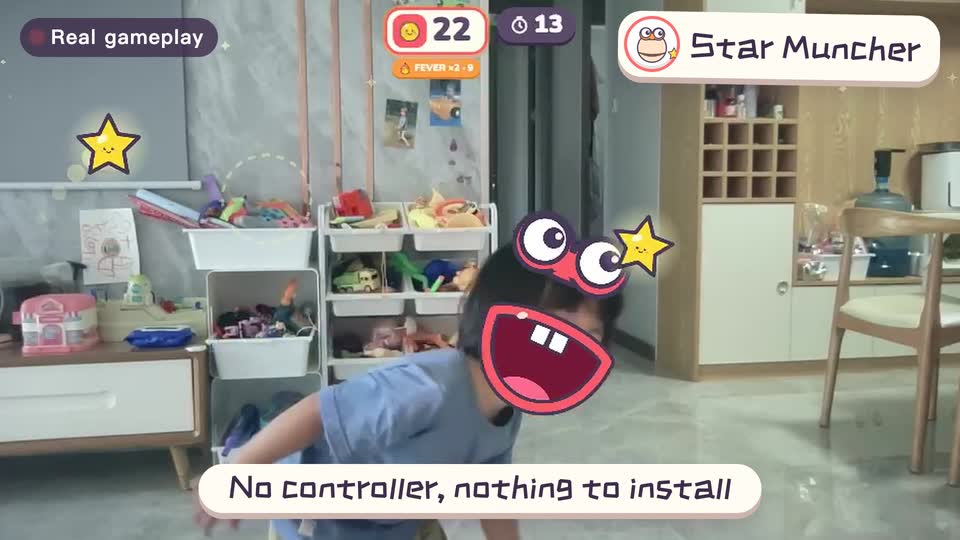
Real footage · 14 s
Kids stand in front of the computer and just move
100+ motion games for ages 3 to 18. Open the website and play: nothing to install, and the camera picture stays on this computer.
Sources
- Oculus Rift is Shipping. Oculus Blog (Internet Archive copy). Shipping began March 28, 2016
- SteamVR Tracking (Steam Dev Days 2016 slides). Valve. Base stations sweep lasers across the room; sensors on the devices time the sweeps to work out angles
- VIVE Year One. HTC VIVE Blog. April 5, 2017: one year of consumer room-scale VR
- PlayStation Makes Virtual Reality Mainstream With Launch of PlayStation VR. Sony Interactive Entertainment America press release. October 13, 2016, $399
- Business Data & Sales (PlayStation VR). Sony Interactive Entertainment (Internet Archive copy). 5 million sold worldwide as of December 31, 2019
- It’s Game Time: Oculus Quest and Rift S Now Available. Oculus Blog (Internet Archive copy). Shipping May 21, 2019, from $399
- Powered by AI: Oculus Insight. Facebook AI Blog (Internet Archive copy). August 2019: ultra-wide cameras and inertial sensors on the headset track inside-out
- Thumbs Up: Hand Tracking on Oculus Quest This Week. Oculus Blog (Internet Archive copy). Hand tracking as an experimental feature from December 2019
- From Bear to Bull: How Oculus Quest 2 Is Changing the Game for VR. Oculus Blog (Internet Archive copy). February 2021: Beat Saber has sold over 4 million copies across platforms
- Introducing Apple Vision Pro (Chinese edition). Apple Newsroom. June 5, 2023: controlled with eyes, hands and voice
- Set up your boundary for Meta Quest. Meta. At least 2 m × 2 m recommended for moving around; 1 m × 1 m by default for stationary play