 DongDong Park
Before the Wii: balance boards, mats, gloves and dance pads (1982–2004)
Updated
Before the 2006 Wii, motion games mostly meant add-ons for a console: balance boards and mats to stand on, arcade machines to ride, a glove to wear, an infrared ring around your feet, dance pads to stomp on, and tilt sensors inside cartridges. Each found its own way to sense the body, but apart from dance machines, most of them never caught on.
Timeline
| When | Device | How it sensed the body | What happened |
|---|---|---|---|
| Early 1980s | Joyboard balance board (with a skiing game) | The player stands on it and leans | The first balance board for a games console, per Guinness |
| July 1985 | Sega Hang-On arcade machine | The player leans a motorbike-shaped cabinet, up to 12 degrees each way | Start of the “taikan game” arcade genre |
| Mid-1980s | Bandai Family Trainer / Nintendo Power Pad | A two-sided pressure mat you step on | A Nintendo-branded set in North America by 1988 |
| October 1989 | Power Glove | Ultrasound locates the hand; bend sensors measure the fingers | Inaccurate and hard to calibrate; off the market about a year later |
| 1993 | Sega Activator ring | Eight panels shine infrared light upward; hands and feet reflect it back | Needed a white ceiling and white socks; soon pulled |
| 1998 | Microsoft SideWinder Freestyle Pro and other gamepads | An accelerometer in the gamepad senses tilt | A niche PC product |
| September 1998 | Konami Dance Dance Revolution | Step switches under the arrow panels | The best-selling dance mat game series (Guinness) |
| August 2000 | Nintendo Kirby Tilt ’n’ Tumble | An acceleration sensor in the cartridge: tilt the console | Sensor and game designed together |
| October 2004 | Nintendo WarioWare: Twisted! | A gyro sensor in the cartridge: turn the console | Paved the way for the Wii Remote |
Standing on it: balance boards and pressure mats
Guinness World Records lists the Joyboard as the first balance board peripheral for a games console: players stood on it and leaned left and right to steer a skier in Mogul Maniac. The record says Atari released it in 1982; COMPUTE! magazine reported in September 1983 that the Amiga company made it for Atari and other systems, for about $50, and described it as a controller you work with your whole body rather than just your hands. The two accounts differ, so it is safest to call it an early-1980s product.
In the mid-1980s Bandai released the Family Trainer in Japan: a two-sided pressure mat laid on the floor that players stepped, ran and jumped on to control the game. It was later sold in North America as Nintendo’s Power Pad, and the Computer History Museum holds a Nintendo “Power Set” made in 1988 (the Power Pad plus the track-and-field game World Class Track Meet).
Riding it: arcade ride-ons
Sega’s 1985 Hang-On put players on a motorbike-shaped cabinet that they leaned into corners (up to 12 degrees each way), and moving cockpits and steering-wheel racers followed. The Japanese arcade business called these big machines taikan games, which is where the word comes from (see What was the first motion game?). They were hits in arcades, but too big and too expensive for homes.
Wearing it: the Power Glove (1989)
The Power Glove, released in October 1989, was developed by Abrams/Gentile Entertainment and Mattel, not by Nintendo itself. Two ultrasonic transmitters on the back of the hand and three receivers around the TV worked out the hand’s position and direction by triangulation, while bend sensors made of a conductive material ran along the fingers: the more a finger bent, the more the resistance changed. The idea came from the “data gloves” used in research; as the developers remember it, they turned a device costing about $10,000 into a toy with about $26 worth of materials.
It didn’t go well. The cheap parts made the connection unreliable and the tracking imprecise, the ultrasonic tracking was hard to calibrate, and very few games were made for it; it left the market about a year later. Sales estimates vary (from just over a million to about two million), but it is widely seen as a flop.
Standing inside it: the Sega Activator (1993)
In 1993 Sega released the Activator for the Mega Drive (Genesis in North America): a ring of eight panels on the floor, each with an infrared LED and a photodiode. Reaching a hand or foot into the beam above a panel reflected the infrared light back, which counted as pressing one direction on the controller. According to a review in Electronic Games magazine, the beams pointed at the ceiling, so a white, reflective ceiling worked best and a very high one didn’t work at all; the magazine even suggested wearing white socks. Unreliable and priced at $80 to $150, it quietly disappeared.
Stepping on it: dance machines (1998)
Konami’s Dance Dance Revolution (DDR) started running in Japanese arcades in September 1998 (Konami’s date; Guinness says November 1998). Players stepped on arrow panels to the music, matching the arrows rising up the screen. According to Konami’s patent, a step switch sits between each panel and the base; in the 3 × 3 grid, the four panels in front, behind, left and right are live.
It was the most successful motion game of the period: Guinness lists it as the best-selling dance mat game series (about 21.67 million by 2016, from third-party data), more than 100 versions have come out since 1998, and in 2022 it entered the World Video Game Hall of Fame at The Strong museum in the US. In 2006 it also went into PE classes in West Virginia’s public schools (see Motion games in schools).
Holding it: tilt sensors (1998–2004)
The other path was to put an accelerometer into something held in the hand. According to Analog Dialogue, the technical journal of the accelerometer maker Analog Devices, PC gamepads such as Microsoft’s 1998 SideWinder Freestyle Pro already sensed tilt with an accelerometer. In August 2000, Nintendo used a “motion-sensing cartridge” in Kirby Tilt ’n’ Tumble for Game Boy Color: an acceleration sensor sat inside the cartridge, and tilting the console rolled Kirby. WarioWare: Twisted! for Game Boy Advance (October 2004 in Japan) switched to a “newly developed gyro sensor” in the cartridge, so you played by turning the console.
These small sensors in your hand later became the heart of the Wii Remote, smartphones and today’s motion controllers (see How motion games work).
Why most of them flopped
- You had to buy an extra device. It didn’t come with the console and cost extra, so few people bought it, and even fewer companies wanted to make games for it.
- Too few games. The Power Glove only worked with a handful of games written for it.
- Inaccurate and hard to calibrate. Ultrasound and infrared aimed at the ceiling were easily thrown off by the room.
- Demanding about the room. Ceiling color and height, floor space: most homes couldn’t meet them.
Dance machines were the exception: the game was designed for the pads, a pad can tell exactly whether you stepped on the beat, and arcades gave players an audience and a social scene. The 2006 Wii took a different approach: its motion controller came standard with the console, and games were built around it from the start (see The Wii).
Common questions
How did motion gaming develop before the Wii?
The 1980s had light guns, balance boards, pressure mats and ride-on arcade machines. The 1989 data glove and the 1993 infrared ring both flopped, while the 1998 dance machine was a big hit. Then EyeToy (2003) brought the camera into the living room, the Wii (2006) made motion controllers common, Kinect (2010) needed nothing in your hands, and later came Ring Fit, VR and ordinary cameras.
How does a dance mat sense your steps?
According to Konami’s patent, a step switch sits between each panel and the base and closes when you step on it. In the 3 × 3 grid, the four panels in front, behind, left and right are live, and the game checks whether you hit the right one as each arrow arrives.
Why did the Power Glove fail?
Cheap parts made the connection unreliable and the tracking imprecise, the ultrasonic tracking was hard to calibrate, and very few games were designed for it. It left the market about a year after launch.
More in “The history of motion games, from light guns to webcams”
- The history of motion games, from light guns to webcams (overview)
- What was the first motion game?
- EyeToy (2003): the camera comes to the living room
- The Wii (2006): motion controls for the whole family
- Kinect (2010): nothing to hold, and why it was discontinued
- PlayStation Move, Switch and Ring Fit: motion games turn to fitness
- Motion games in VR: from room-scale tracking to Beat Saber
- Motion games in schools: from DDR in PE class to today
- Webcams and the browser: motion games without special hardware
- Why did motion gaming fade, and where did it go?
Games mentioned here
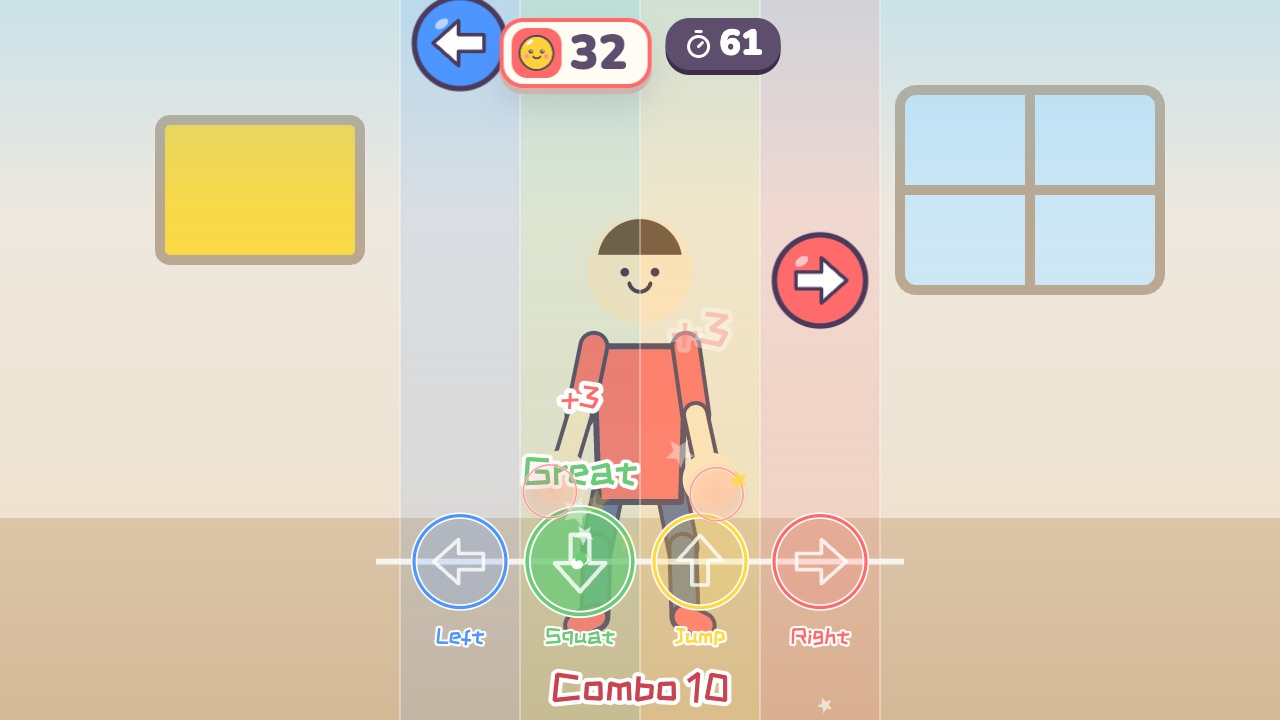 Rhythm StepsFollow the beat: step left, step right, jump and squatAges 6–16 · High activity · Rhythm / Whole body / Run & jump
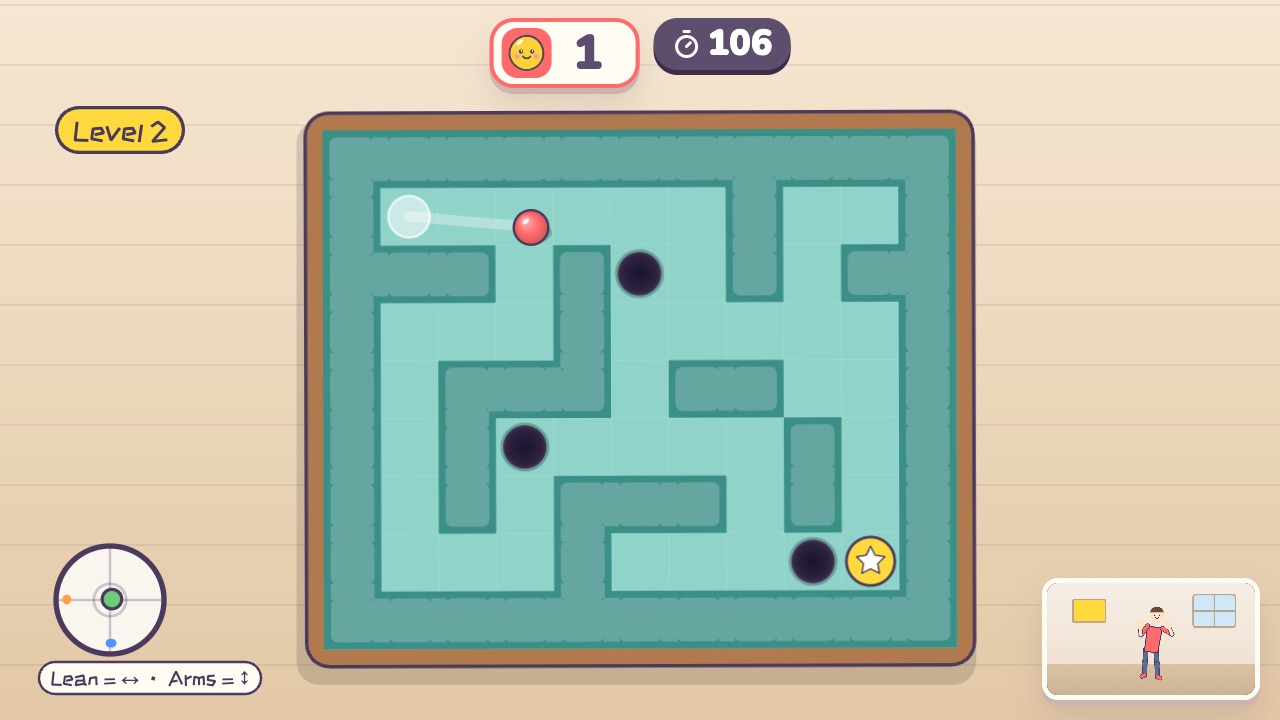 Tilt MazeLean your body to tilt the maze and roll the ball to the finishAges 9–18 · Light activity · Whole body / Thinking / Calm
 Slalom SkiLean left and right to ski through the flag gatesAges 5–10 · Moderate activity · Whole body
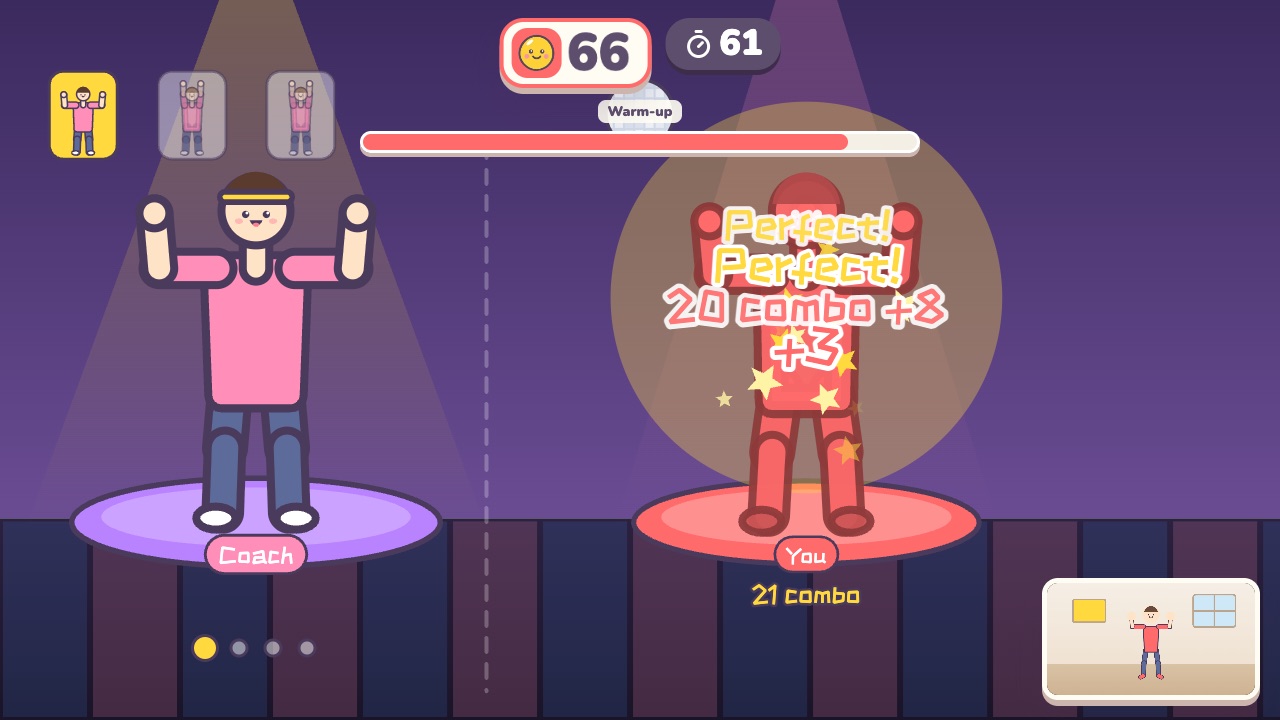 Dance AlongDance with the coach. Every beat is scored on how well you match the moveAges 12–18 · High activity · Rhythm / Whole body

Real footage · 14 s
Kids stand in front of the computer and just move
100+ motion games for ages 3 to 18. Open the website and play: nothing to install, and the camera picture stays on this computer.
Sources
- First balance board peripheral for a gaming console. Guinness World Records. The Joyboard, with the skiing game Mogul Maniac
- Game Machine (ゲームマシン), no. 265. Japanese arcade-industry trade magazine. August 1, 1985: in Hang-On, players shift their weight to lean the bike, up to 12 degrees each way
- Nintendo Power Set (Power Pad and World Class Track Meet). Computer History Museum, catalog no. 102688074. Made in 1988
- Nintendo NES Power Glove. Australian Centre for the Moving Image (ACMI). Released October 1989; developed by Abrams/Gentile Entertainment and Mattel
- US Patent 5,086,785 (finger flex sensor). Abrams/Gentile Entertainment. Filed 1989: finger bend measured by the changing resistance of a conductive material
- Losing Their Grip: An Oral History of Nintendo’s Power Glove. Mental Floss. February 2017; the developers’ recollections
- European Patent EP0557111 (infrared panel sensing). Interactive Light Inc.. Published 1993; the embodiment is designed for the Sega Genesis: one infrared LED and one photodiode per panel
- Electronic Games, May 1994 (Test Lab: Sega Activator). US games magazine (Internet Archive scan). Infrared beams aimed at the ceiling; a white, reflective ceiling works best; white socks recommended
- Konami Amusement news, March 17, 2022 (DanceDanceRevolution). Konami Amusement (Japanese site). Began running in Japanese arcades in September 1998
- US Patent 6,227,968 (dance-pad step sensor). Konami. Priority date July 1998: step switches between the panels and the base
- Best-selling dance mat game series. Guinness World Records. About 21.67 million as of March 14, 2016 (data from VGChartz)
- World Video Game Hall of Fame Inductees for 2022 Announced. The Strong National Museum of Play. May 2022: Dance Dance Revolution inducted
- 3D Sensors in Intuitive Game Design. Analog Devices, Analog Dialogue, vol. 41. April 2007: accelerometers in Microsoft’s 1998 SideWinder Freestyle Pro and other gamepads, and in Nintendo cartridges
- コロコロカービィ (Kirby Tilt ’n’ Tumble), Kirby news. Nintendo (Japanese site). A “motion-sensing cartridge”: tilt the Game Boy Color to roll Kirby
- まわる メイド イン ワリオ (WarioWare: Twisted!). Nintendo (Japanese site). Released October 14, 2004; the cartridge holds a “newly developed gyro sensor”