 DongDong Park
The history of motion games, from light guns to webcams
Updated
In short: playing with your whole body started in 1970s American interactive art, where Myron Krueger’s VIDEOPLACE used a video camera to capture a person’s outline. Nintendo built a commercial light-gun shooting range in 1973, and in 1985 Sega’s ride-on arcade machines made the Japanese term “taikan game” (body-sensation game) popular. From the 1980s to the early 2000s came balance boards, floor mats, a data glove, an infrared ring and dance machines; apart from the dance machines, most flopped. In 2003 Sony’s EyeToy put a camera in the living room, in 2006 the Nintendo Wii made a motion controller standard (101.63 million consoles sold), and in 2010 Microsoft’s Kinect let players hold nothing at all. In the late 2010s motion games turned to fitness (Ring Fit Adventure), VR (Quest, Beat Saber) and ordinary cameras that can recognize poses, and schools have tried them in PE since 2006.
Five stages
| Stage | Examples | What defined it | Read more |
|---|---|---|---|
| 1970–1984: beginnings | VIDEOPLACE, the Laser Clay Shooting System, the Famicom light gun | Art installations and light guns; moving your body wasn’t a game genre yet | Origins |
| 1982–2004: add-ons and arcades | Balance board, ride-on arcade machines, floor mats, a data glove, dance machines, tilt-sensing cartridges | Each tried its own way of sensing the body; mostly add-ons, few hits | Early devices |
| 2003–2013: going mainstream | EyeToy, Wii, Kinect, PlayStation Move | Cameras and motion controllers became console selling points and reached millions of living rooms | EyeToy, Wii, Kinect |
| 2014–2020: a change of direction | Switch, Ring Fit Adventure, Oculus / Vive / PS VR, Beat Saber | Console motion add-ons faded; motion play moved to fitness and VR | Move and Ring Fit, VR |
| 2014–today: cameras and AI | Pose-estimation research, dancing in front of a phone camera, motion games in the browser | Nothing to buy and nothing to hold: an ordinary camera can recognize poses | Webcams, Schools |
Full timeline (1971–2025)
| Year | What happened | Read more |
|---|---|---|
| 1971 | Myron Krueger’s PSYCHIC SPACE senses where people walk with a floor of pressure switches | Origins |
| 1973 | Nintendo develops the Laser Clay Shooting System, turning bowling alleys into virtual clay-pigeon ranges | Origins |
| 1975 | First version of Krueger’s VIDEOPLACE shown: a video camera captures a person’s outline, which interacts with shapes on screen | Origins |
| Early 1980s | The Joyboard balance board: stand on it and lean to ski | Early devices |
| 1984 | The Famicom light gun (February) and Duck Hunt (April) | Origins |
| 1985 | Sega’s Hang-On: lean the bike to take corners; by December, Sega ads speak of “taikan shooting” | Origins |
| Mid-1980s | Bandai’s Family Trainer pressure mat, sold in North America as the Power Pad | Early devices |
| 1986 | Sega calls Out Run and similar arcade cabinets “taikan games” | Origins |
| 1989 | The Power Glove: ultrasonic tracking; off the market about a year later | Early devices |
| 1993 | The Sega Activator infrared ring, soon pulled | Early devices |
| 1998 | Konami’s Dance Dance Revolution; PC gamepads start using accelerometers | Early devices |
| 2000 | Nintendo’s Kirby Tilt ’n’ Tumble: an acceleration sensor inside the cartridge | Early devices |
| 2003 | Sony EyeToy: a USB camera for PS2; 1 million sold in Europe in four months | EyeToy |
| 2006 | Nintendo Wii launches, and a motion controller comes with every console | Wii |
| 2006 | West Virginia announces dance games for public-school PE | Schools |
| 2007 | Wii Fit and the Balance Board (four strain-gauge sensors) | Wii |
| 2009 | Wii MotionPlus adds a gyroscope; the first Just Dance | Wii |
| 2010 | Microsoft Kinect: a depth camera, nothing to hold | Kinect |
| 2010 | Sony PlayStation Move: a camera tracks a glowing ball | Move and Ring Fit |
| 2013 | Xbox One ships with the second-generation Kinect (time-of-flight) | Kinect |
| 2014 | Google’s DeepPose: estimating body pose from ordinary photos | Webcams |
| 2014 | Xbox One goes on sale without Kinect | Kinect |
| 2016 | Oculus Rift, HTC Vive and PlayStation VR launch | VR |
| 2017 | Nintendo Switch: Joy-Con with an accelerometer, a gyroscope and an IR motion camera | Move and Ring Fit |
| 2017 | Carnegie Mellon publishes real-time multi-person pose estimation (later open-sourced as OpenPose) | Webcams |
| 2017 | Kinect reportedly discontinued | Kinect |
| 2018 | The VR rhythm game Beat Saber | VR |
| 2019 | Oculus Quest standalone headset; hand tracking by the end of the year | VR |
| 2019 | Ring Fit Adventure: a force sensor and a leg-strapped controller turn motion play into exercise | Move and Ring Fit |
| 2022 | Nintendo Switch Sports | Move and Ring Fit |
| 2023 | Azure Kinect Developer Kit discontinued | Kinect |
| 2023 | Just Dance tests full-body tracking with a phone camera | Move and Ring Fit |
| 2024 | Apple Vision Pro: controlled with eyes, hands and voice | VR |
| 2025 | Switch 2: Joy-Con 2 can also work as a mouse | Move and Ring Fit |
Each generation sensed the body in its own way: light sensors, pressure, motion sensors, infrared dots, depth cameras, and ordinary cameras with software that recognizes poses. How each of them works is explained in How motion games work.
Key numbers
| Product | Number | As of · source |
|---|---|---|
| Wii console | 101.63 million | September 30, 2026 · Nintendo |
| Wii Sports | 82.90 million (mostly bundled with the console) | March 31, 2024 · Nintendo |
| Wii Fit | 22.67 million | March 31, 2024 · Nintendo |
| Nintendo Switch Sports | 18.32 million | March 31, 2026 · Nintendo |
| Ring Fit Adventure | 15.38 million | March 31, 2023 · Nintendo |
| Just Dance series | More than 90 million | 2024 · Ubisoft |
| Dance Dance Revolution series | About 21.67 million | 2016 · Guinness World Records (from third-party estimates) |
| Kinect | 133,333 a day on average in its first 60 days | 2010–2011 · Guinness World Records |
| Kinect, lifetime | About 35 million | 2017 · as reported by Fast Company |
| PlayStation Move | More than 8 million shipped | April 3, 2011 · Sony |
| PlayStation VR | 5 million | December 31, 2019 · Sony |
| EyeToy series | More than 2.4 million shipped | January 2004 · Sony |
| Beat Saber | More than 4 million | February 2021 · Oculus |
Companies count in different ways: some report units “shipped” to retailers, others units “sold” to players, and Nintendo’s software figures include copies bundled with consoles. Keep that in mind before comparing one number with another.
Common myths, checked
These claims are repeated all over the internet, but they don’t match the original sources:
| The claim | What the sources say |
|---|---|
| “EyeToy was the first motion device to sell 10 million.” | We found no source for this. Sony reported more than 2.4 million shipped by January 2004; “10.5 million cameras worldwide” appears only in a 2008 article that gives no source. |
| “Kirby Tilt ’n’ Tumble was the first game to use an accelerometer.” | PC gamepads from Microsoft and others already sensed tilt with accelerometers in 1998. What Nintendo did was design the sensor and the game together and put the sensor in the cartridge. |
| “Nintendo made the Power Glove.” | It was developed by Abrams/Gentile Entertainment and Mattel. |
| “A light gun shoots light.” | The gun sends out nothing. A light sensor inside it picks up a white box flashed on the screen. |
| “The Wii sensor bar senses the player.” | The sensor bar is just two groups of infrared lights (five each). The front of the remote does the seeing. |
| “The Wii Balance Board uses pressure sensors.” | Nintendo’s developers said there is a strain-gauge sensor in each of its four feet. |
| “Ring Fit’s Ring-Con uses a bend sensor.” | Nintendo calls it a force sensor, which senses pushing and pulling. |
| “Kinect is the fastest-selling consumer electronics device.” | Guinness now lists it as the fastest-selling gaming peripheral. It was announced with the consumer-electronics title in 2011; that record now names the iPad. |
| “Hold the Wii Remote 3 to 8 feet from the TV.” | Nintendo’s manual says 1 to 3 m (3 to 10 feet) from the sensor bar. |
| “The Wii invented motion gaming.” | Light guns (1970s–1980s), ride-on arcade machines (1985), dance machines (1998) and EyeToy (2003) all came first. The Wii is the console that made it mainstream. |
How we checked this series
Every year, price and sales figure in this series was checked against original sources in November 2026: company press releases, investor-relations data, manuals and support pages (Nintendo, Microsoft, Sony, Konami, Ubisoft, Meta, Apple), patents, trade magazines of the time (the Japanese arcade-industry magazine Game Machine), museum catalog records (the Computer History Museum, The Strong National Museum of Play, the Australian Centre for the Moving Image), Guinness World Records and academic papers. Where an official page has gone offline, we link to its Internet Archive copy.
- Where sources disagree (for example the month Dance Dance Revolution launched, or how many West Virginia schools took part), we give both.
- Numbers found only in media reports, with no official source (such as Kinect’s lifetime total of about 35 million), are marked as reported.
- What we couldn’t verify (such as “EyeToy was the first motion device to sell 10 million”) is left out.
Every page ends with its sources and links, so you can read the originals. If you spot a mistake or have a better source, please tell us.
Common questions
What is the history of motion gaming, in brief?
In the 1970s, artists built interactive installations with video cameras and pressure-sensing floors. Commercial light-gun shooting arrived in 1973, and around 1985 Sega’s arcade machines made the Japanese term “taikan game” popular. From the 1980s to the 2000s, balance boards, floor mats, a data glove and dance machines were mostly add-ons. EyeToy (2003), the Wii (2006) and Kinect (2010) brought motion games into homes; after that the field turned to Ring Fit, VR and ordinary cameras that recognize poses.
What are the stages of motion gaming history?
Five: beginnings, 1970–1984 (art installations, light guns); add-ons and arcades, 1982–2004; going mainstream, 2003–2013 (EyeToy, Wii, Kinect, Move); a turn to fitness and VR, 2014–2020; and ordinary cameras that recognize poses, 2014 to today.
What is the best-selling motion game?
As a single game, Wii Sports: 82.90 million copies as of March 31, 2024, according to Nintendo (in most regions it came with the console). As a series, Ubisoft’s Just Dance, which Ubisoft said in 2024 had sold more than 90 million copies.
What are the best-known motion gaming devices?
Light guns, balance boards and dance mats in the 1980s, the EyeToy camera in 2003, the Wii in 2006, Kinect and PlayStation Move in 2010, the Switch in 2017, Ring Fit Adventure in 2019, and VR headsets from 2016 on.
In this series
- What was the first motion game?
- Before the Wii: balance boards, mats, gloves and dance pads (1982–2004)
- EyeToy (2003): the camera comes to the living room
- The Wii (2006): motion controls for the whole family
- Kinect (2010): nothing to hold, and why it was discontinued
- PlayStation Move, Switch and Ring Fit: motion games turn to fitness
- Motion games in VR: from room-scale tracking to Beat Saber
- Motion games in schools: from DDR in PE class to today
- Webcams and the browser: motion games without special hardware
- Why did motion gaming fade, and where did it go?
Games mentioned here
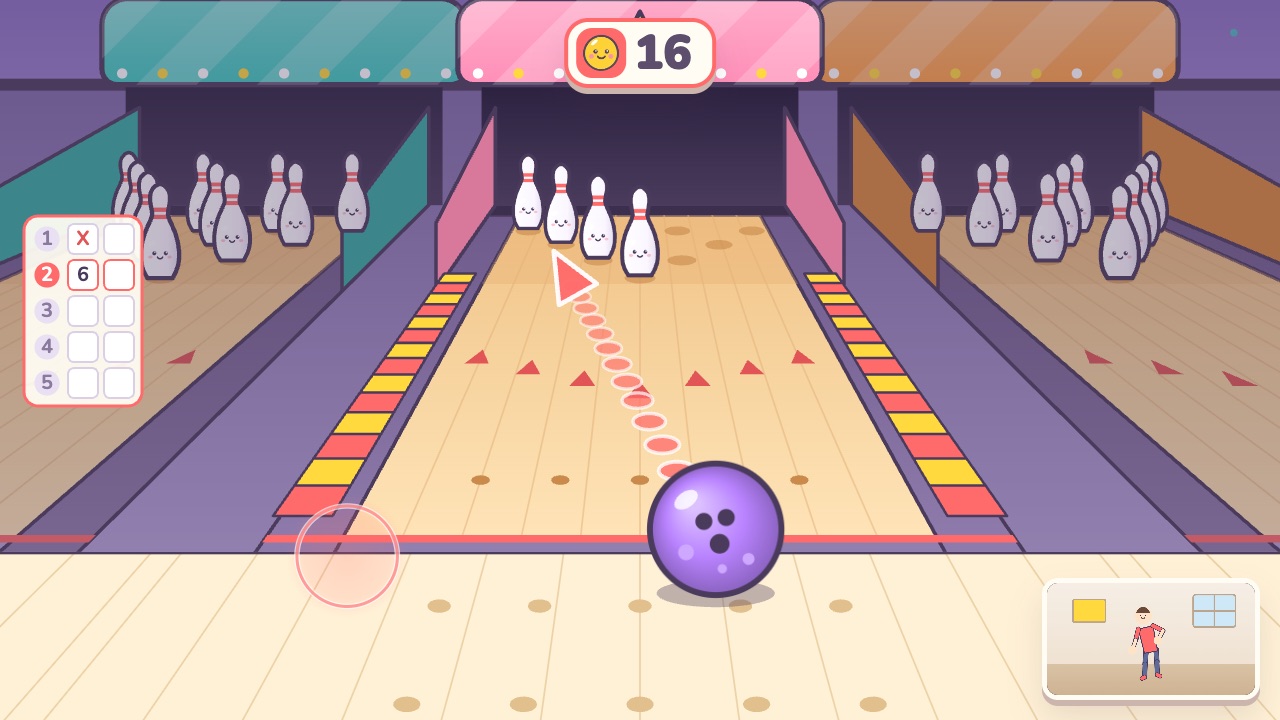 BowlingSwing your arm back and fling the ball forward. Lean your body to aimAges 5–14 · Moderate activity · Hands
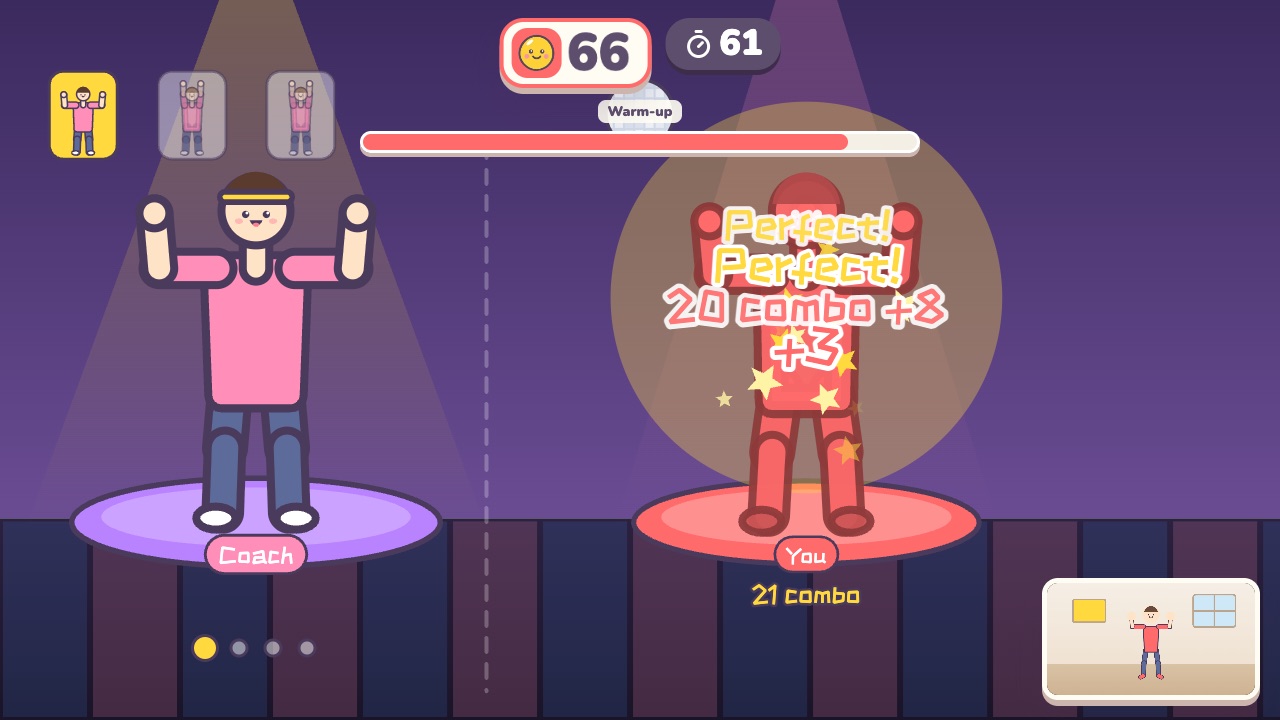 Dance AlongDance with the coach. Every beat is scored on how well you match the moveAges 12–18 · High activity · Rhythm / Whole body
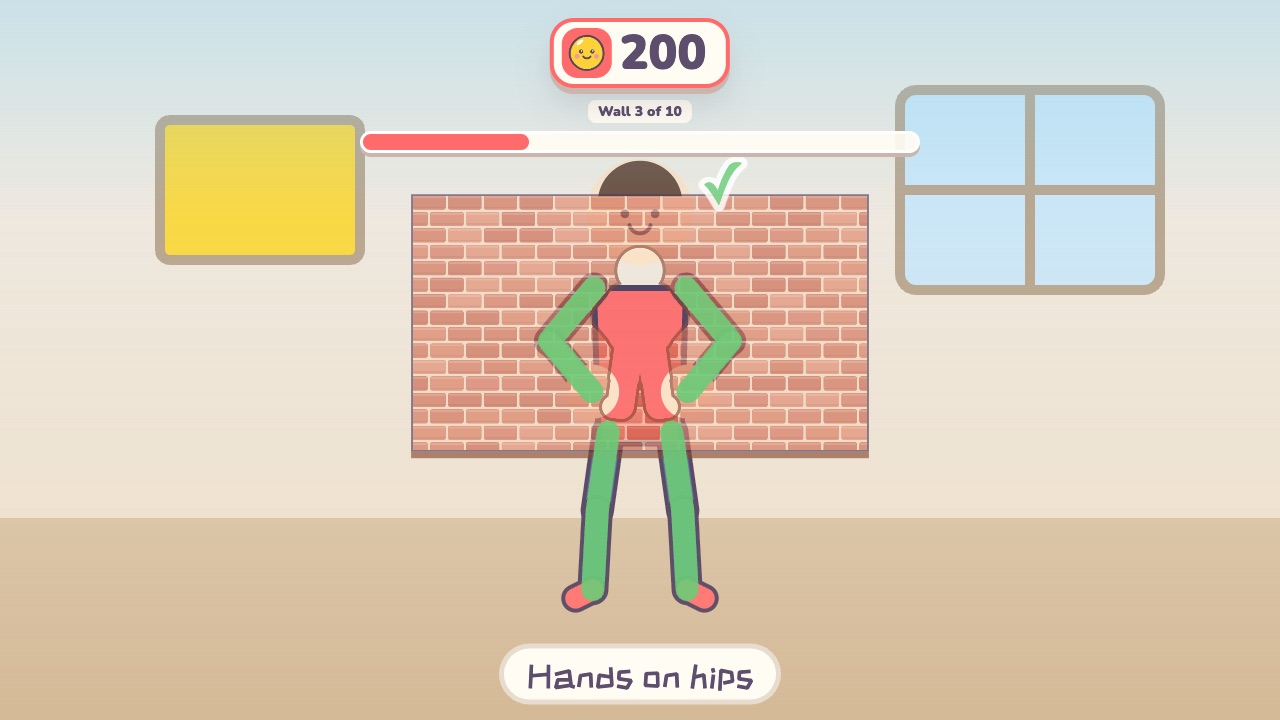 Shape WallMake the same shape as the hole in the wallAges 4–12 · Moderate activity · Whole body / Thinking
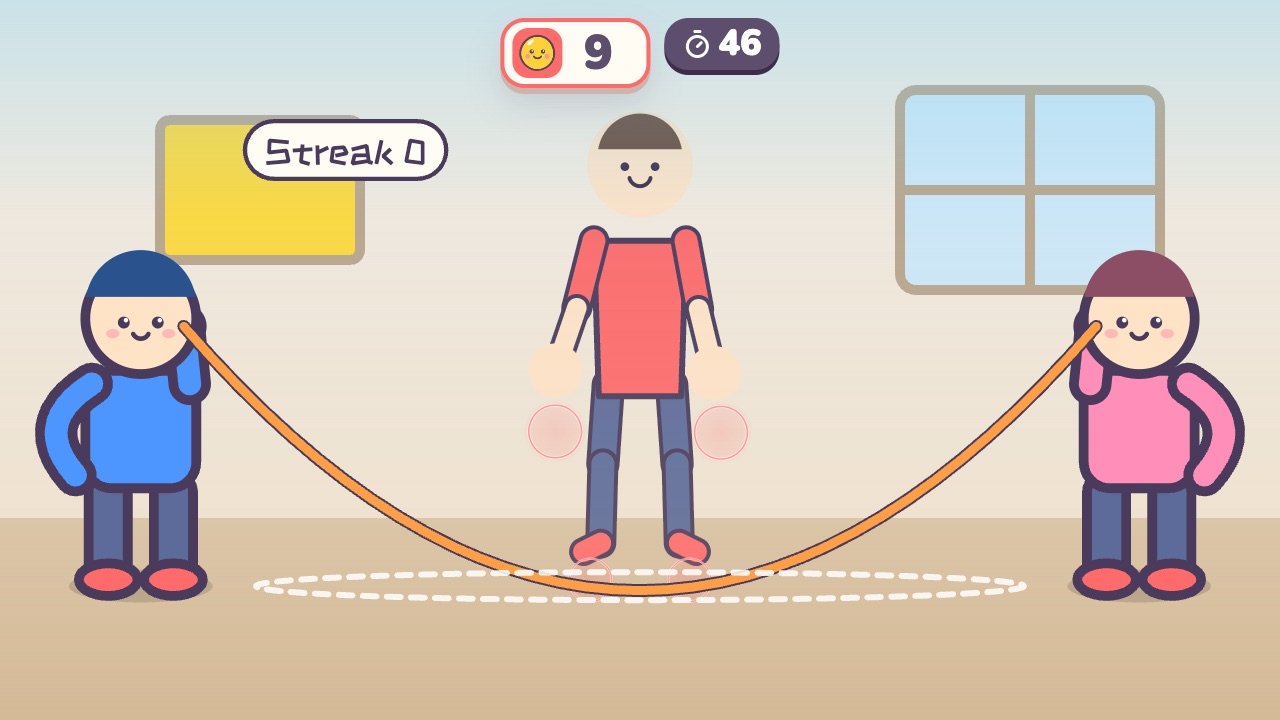 Jump Rope ChampJump when the rope sweeps under your feet. The longer your streak, the faster the ropeAges 6–14 · High activity · Run & jump / Fitness / Rhythm
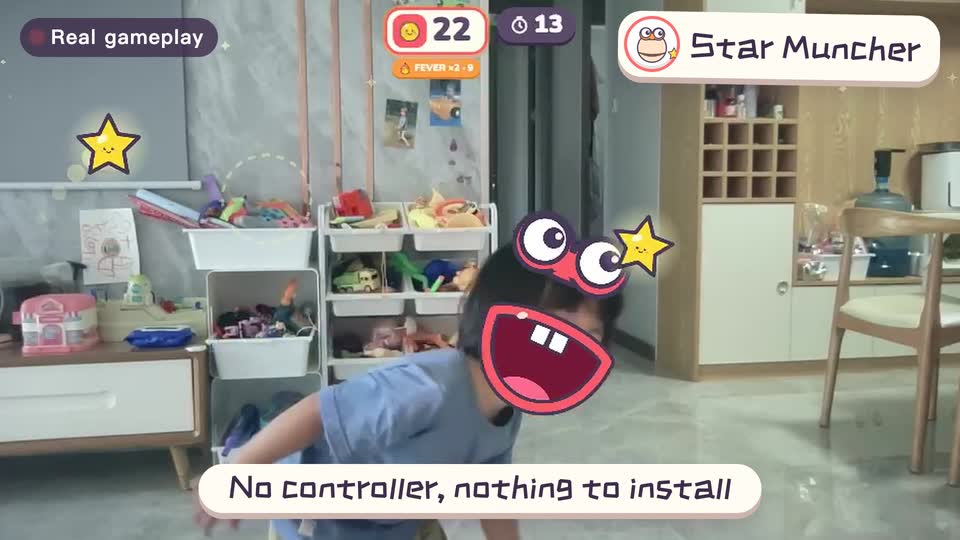
Real footage · 14 s
Kids stand in front of the computer and just move
100+ motion games for ages 3 to 18. Open the website and play: nothing to install, and the camera picture stays on this computer.
Sources
- Responsive Environments. Myron W. Krueger, AFIPS National Computer Conference Proceedings, vol. 46. 1977; the first VIDEOPLACE was shown for six weeks at the Milwaukee Art Center from October 1975; PSYCHIC SPACE (1971) sensed people with a floor of pressure switches
- Company history (会社の沿革). Nintendo (Japanese site). 1973: develops the commercial Laser Clay Shooting System
- Family Computer history (ファミリーコンピュータ ヒストリー). Nintendo (Japanese site). Light gun released February 18, 1984; Duck Hunt April 21, 1984
- Game Machine (ゲームマシン), no. 295. Japanese arcade-industry trade magazine. November 1, 1986: Sega calls Out Run the culmination of its taikan game series
- Best-selling dance mat game series. Guinness World Records. About 21.67 million as of March 14, 2016 (data from VGChartz)
- EyeToy is Set to Revolutionize the Market. Sony Computer Entertainment America press release. November 4, 2003; 1 million sold in Europe in four months
- Iwata Asks: Wii Remote. Nintendo. An accelerometer plus an absolute reference point next to the TV: the sensor bar
- Dedicated Video Game Sales Units. Nintendo Investor Relations. As of September 30, 2026: Wii 101.63 million, Switch 157.20 million, Switch 2 26.35 million
- Top Selling Title Sales Units: Wii Software. Nintendo Investor Relations (Internet Archive copy). As of March 31, 2024: Wii Sports 82.90 million, Wii Fit 22.67 million, Wii Fit Plus 21.13 million (bundled copies included)
- Fastest-selling gaming peripheral. Guinness World Records. Kinect for Xbox 360: 133,333 a day on average in its first 60 days
- Real-Time Human Pose Recognition in Parts from Single Depth Images. Shotton et al. (Microsoft Research Cambridge, Xbox Incubation), CVPR 2011. Labels body parts pixel by pixel in a single depth image; under 5 ms per frame on Xbox 360
- PlayStation Move (press release). Sony Computer Entertainment. March 2010: a camera tracks the glowing sphere; three-axis gyroscope, three-axis accelerometer and geomagnetic sensor inside
- Ring Fit Adventure: Ring-Con and Leg Strap (リングフィット アドベンチャー). Nintendo (Japanese site). A force sensor in the Ring-Con senses pushing and pulling; the Joy-Con in the Leg Strap senses jogging and knee bends; released October 18, 2019
- Financial results explanatory material, fiscal year ended March 2026 (million-seller titles). Nintendo Investor Relations. As of March 31, 2026: Nintendo Switch Sports 18.32 million; Switch 2 launched June 5, 2025
- Just Dance Celebrates 15th Anniversary. Ubisoft. November 2024: the first game came out November 17, 2009; over 90 million sold across the series
- Powered by AI: Oculus Insight. Facebook AI Blog (Internet Archive copy). August 2019: ultra-wide cameras and inertial sensors on the headset track inside-out
- DeepPose: Human Pose Estimation via Deep Neural Networks. Toshev and Szegedy (Google), CVPR 2014. An early landmark in estimating human pose from photos with deep neural networks
- Realtime Multi-Person 2D Pose Estimation Using Part Affinity Fields. Cao, Simon, Wei and Sheikh (Carnegie Mellon University), CVPR 2017. Real-time pose estimation for several people in one picture; later open-sourced as OpenPose
- Konami Digital Entertainment and the State of West Virginia Develop Groundbreaking Program. Konami (official press release, Internet Archive copy). January 25, 2006: a three-year partnership bringing the dance game into PE or health classes in the state’s public schools