 DongDong Park
EyeToy (2003): the camera comes to the living room
Updated
In 2003 Sony released EyeToy for PlayStation 2: a USB camera that sat on the TV, put the player’s image into the game, and let them play by waving and kicking, with nothing in their hands. It was the first time camera motion games reached large numbers of homes, three years before the Wii and seven before Kinect.
Before it: Mandala at trade shows
Using a camera to watch people and let them interact with pictures had been around in art and exhibitions for years (see Krueger’s VIDEOPLACE in the origins chapter). Vivid Group of Toronto began developing its Mandala system in the 1980s: a video camera filmed a person and “placed” their image inside the computer picture, and touching a shape on screen triggered animation and music. In the early 1990s it appeared several times at Ars Electronica, SIGGRAPH and other shows. It was used mostly at exhibitions and in showrooms and never reached ordinary homes.
Where EyeToy came from
Richard Marks led the development of EyeToy. He wrote on the official PlayStation Blog that it was one of his first big projects after joining Sony in 1999, and according to a games-industry retrospective, he and Sony’s Phil Harrison both believed the PS2 was powerful enough for real-time video processing. The game that came with it, EyeToy: Play, was made by Sony’s London Studio in Europe, and the camera plugged into a USB port on the front of the PS2.
Launch and sales
| When | What happened | Source |
|---|---|---|
| July 2003 | Launched in Europe; about 400,000 sets (game plus camera) sold by late August | The Wall Street Journal |
| November 2003 | Launched in North America; 1 million sold in Europe in four months | Sony press release (US) |
| January 2004 | More than 2.4 million of the EyeToy series shipped | Sony press release |
| 2008 | More than 10.5 million EyeToy cameras sold worldwide | Games-industry article, no source given |
You often read that EyeToy was “the first motion device to sell 10 million.” We found no source that supports this, so we don’t say it.
How it “saw” the player
According to a retrospective on its development, EyeToy’s games kept comparing the pixels of one frame with the next: if the picture changed in some area of the screen, something was moving there, such as a hand reaching a flying target. It is the same idea as the Video Sensing blocks in Scratch today (see Make a motion game in Scratch).
That is why most of its mini-games were about swatting things and touching targets. The limits of the method were obvious too:
- It couldn’t tell a hand from a head, let alone whether someone had squatted or jumped.
- It struggled in the dark, and someone walking behind the player or a curtain moving counted as a move.
What it left behind
- Proof that people would buy controller-free play. One camera and one collection of mini-games sold millions.
- It brought non-gamers in. The movement was the control, with no buttons to learn, so the whole family could play.
- It paved the way. Sony’s later PlayStation Eye and Move (see Move and Ring Fit), Microsoft’s Kinect, which used a depth camera to recognize the whole body (see Kinect), and today’s browser games that recognize poses with an ordinary camera (see Webcams and the browser) all went further down the same road.
Common questions
What is EyeToy?
EyeToy was a USB camera and set of games that Sony released for PlayStation 2 in 2003. The camera filmed the player, and the software compared changes in the picture to tell how they moved, so you could play by waving and kicking, with no controller.
How many EyeToys were sold?
Sony’s press releases say it sold 1 million in Europe in its first four months and that more than 2.4 million of the series had shipped by January 2004. A 2008 games-industry article reported more than 10.5 million cameras sold worldwide, but gave no source.
What is the difference between EyeToy and Kinect?
EyeToy was an ordinary camera that could only tell where the picture was changing. Kinect added a depth camera that measures distance, so it could recognize the whole body’s pose and where the joints were.
More in “The history of motion games, from light guns to webcams”
- The history of motion games, from light guns to webcams (overview)
- What was the first motion game?
- Before the Wii: balance boards, mats, gloves and dance pads (1982–2004)
- The Wii (2006): motion controls for the whole family
- Kinect (2010): nothing to hold, and why it was discontinued
- PlayStation Move, Switch and Ring Fit: motion games turn to fitness
- Motion games in VR: from room-scale tracking to Beat Saber
- Motion games in schools: from DDR in PE class to today
- Webcams and the browser: motion games without special hardware
- Why did motion gaming fade, and where did it go?
Games mentioned here
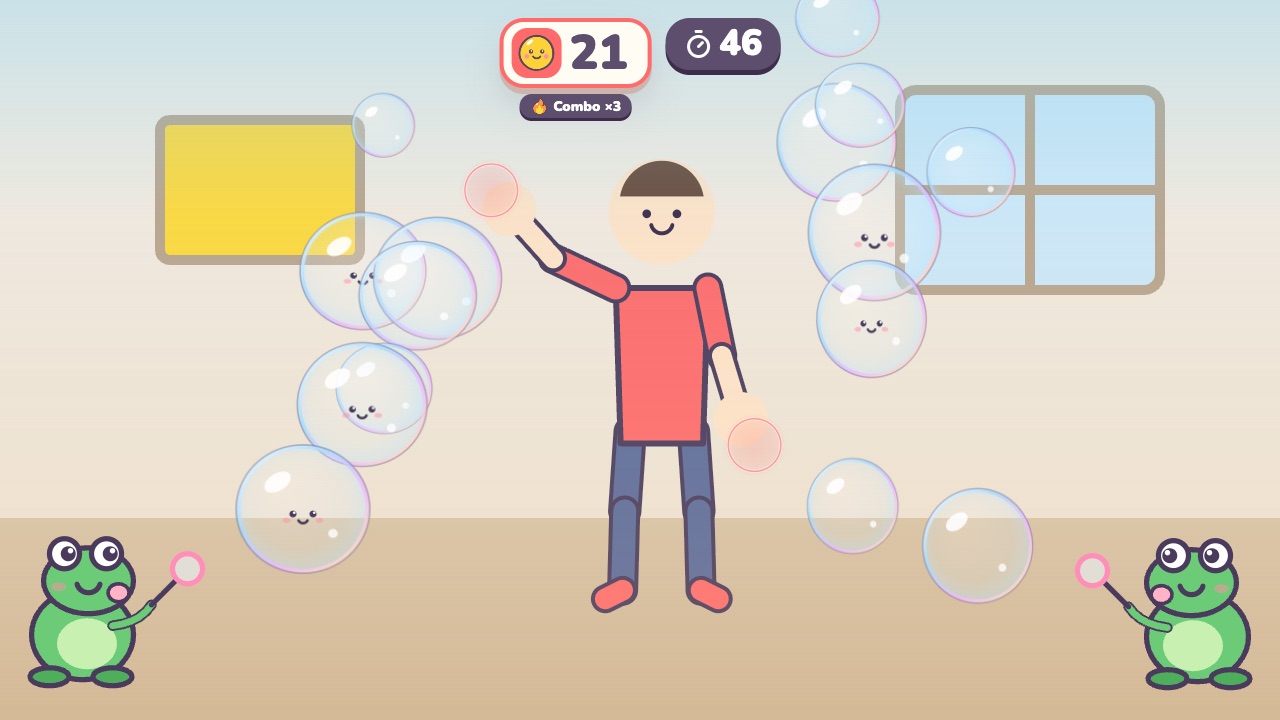 Bubble PopPop the bubbles floating toward youAges 3–7 · Light activity · Hands / Calm
 Mole BopBop the moles that pop up beside you, but not the ones in hard hatsAges 3–9 · Moderate activity · Hands
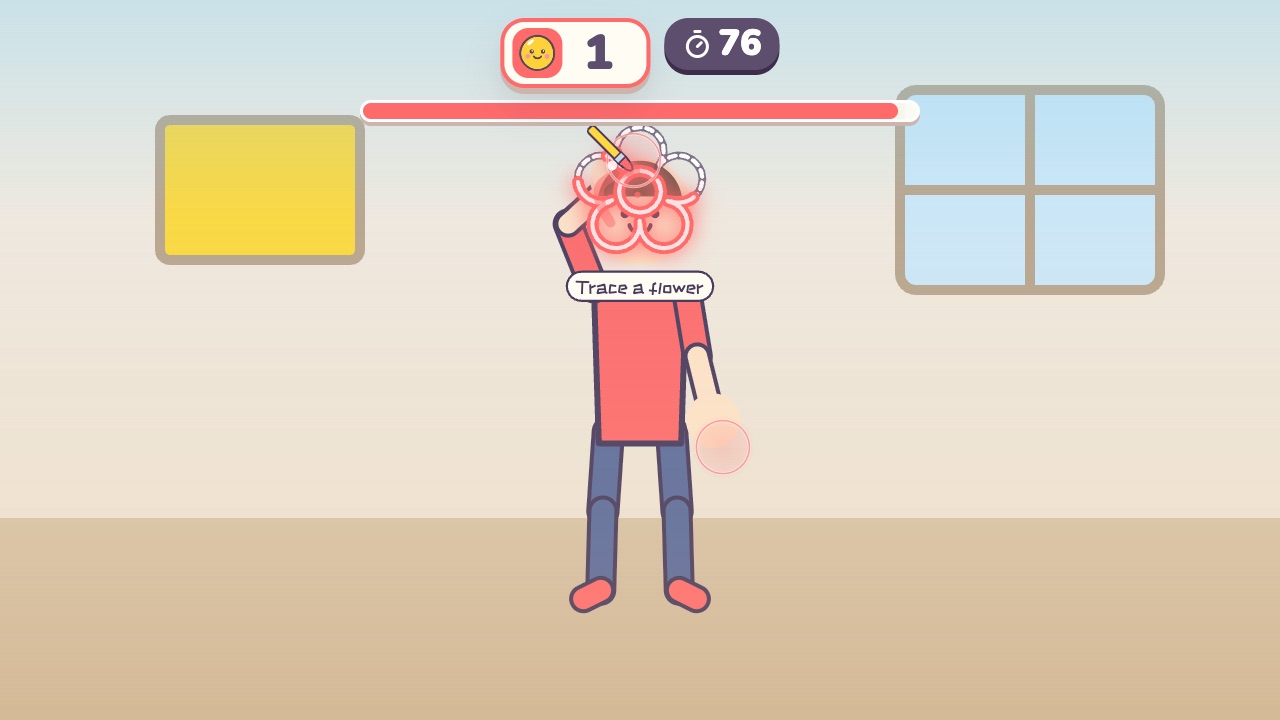 Magic BrushTrace the dotted lines with your hand, and the picture fills with colorAges 3–8 · Light activity · Hands / Calm / Thinking
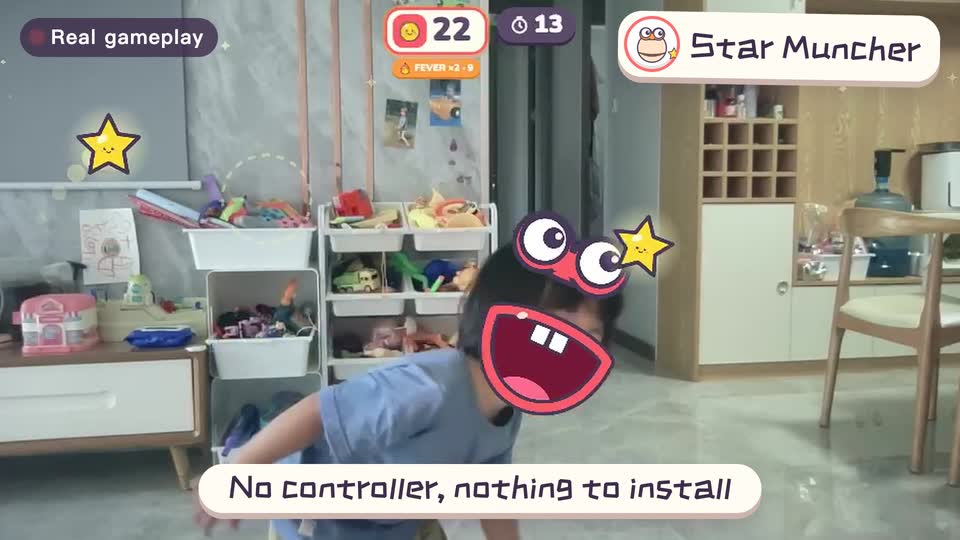
Real footage · 14 s
Kids stand in front of the computer and just move
100+ motion games for ages 3 to 18. Open the website and play: nothing to install, and the camera picture stays on this computer.
Sources
- Mandala (SIGGRAPH 93 Emerging Technologies). ACM SIGGRAPH History Archive. Vivid Group of Canada: a video camera places the person’s image inside the computer picture
- EyeToy, Innovation and Beyond. Richard Marks, PlayStation Blog. November 2010: EyeToy was one of his first big projects after joining Sony in 1999
- Sony Plans to Sell EyeToy in U.S. After Strong Launch. The Wall Street Journal, reprinted on the OmniVision website. August 2003: launched in Europe in July, about 400,000 sold
- EyeToy is Set to Revolutionize the Market. Sony Computer Entertainment America press release. November 4, 2003; 1 million sold in Europe in four months
- EyeToy series ships over 2.4 million (press release). Sony Computer Entertainment. January 14, 2004
- In-Depth: Eye To Eye – The History Of EyeToy. Tom Kim, Gamasutra (Game Developer). November 2008: the software keeps comparing pixel changes; over 10.5 million cameras sold worldwide (no source given)