 DongDong Park
Kinect (2010): nothing to hold, and why it was discontinued
Updated
On November 4, 2010, Microsoft launched Kinect for Xbox 360 in North America. Microsoft’s pitch: play with your body and voice, because you are the controller. It was the first “hold nothing” motion device to reach a mass market, and Guinness World Records lists it as the fastest-selling gaming peripheral. Seven years later, it was discontinued.
Timeline
| When | What happened |
|---|---|
| March 2010 | Microsoft announces that the “Project Natal” sensor is built on a PrimeSense reference design |
| November 4, 2010 | Kinect for Xbox 360 launches in North America, $149.99 on its own |
| November 15, 2010 | Microsoft announces 1 million sold in 10 days |
| 2011 | Microsoft Research presents its Kinect body-part recognition paper at CVPR |
| November 22, 2013 | Xbox One launches with a second-generation Kinect (time-of-flight) in every box |
| June 9, 2014 | Xbox One without Kinect goes on sale for $399 |
| October 2017 | Fast Company reports that Kinect has been discontinued |
| February 2019 | The Azure Kinect Developer Kit is announced for developers |
| August 2023 | Microsoft announces it will stop making the Azure Kinect Developer Kit |
How it saw people: a depth camera plus body-part recognition
According to Microsoft’s developer documentation, Kinect contains a color camera, an infrared emitter and an infrared depth sensor, and an array of four microphones. The emitter projects infrared light into the room and the depth sensor reads the reflection. A Microsoft Research paper calls it a “structured light” sensor: it projects a pattern of dots, and how the pattern is distorted tells how far away each point is. The depth-sensing design came from the Israeli company PrimeSense; in March 2010 Microsoft announced that the sensor was developed from a PrimeSense reference design.
Once you know distances, separating a person from the background is easy. The next question is which part of the body is which. At CVPR 2011, a top computer-vision conference, Microsoft Research Cambridge and the Xbox team presented a paper whose method was to decide, pixel by pixel, which body part each point of a depth image belongs to, and then estimate where the joints are. The paper says training used up to 900,000 synthetic depth images, and that it ran in under 5 ms per frame on the Xbox 360’s graphics processor; Microsoft Research’s page says the paper won that year’s best paper award.
According to the developer documentation, the first Kinect could recognize up to 6 people in view, with detailed skeleton tracking for 2 of them. Its field of view was 57 degrees across and 43 degrees up and down, so players had to stand about 6 feet (1.8 m) away to fit in the picture (see How much space motion games need).
How fast it sold
On November 15, 2010, Microsoft announced 1 million Kinects sold in 10 days. Guinness World Records’ current title for it is fastest-selling gaming peripheral: an average of 133,333 a day in its first 60 days (November 4, 2010 to January 3, 2011), or about 8 million in all.
You often read that Kinect is “the fastest-selling consumer electronics device.” Guinness and Microsoft did announce that in 2011, but Guinness’s page for that title now names the iPad. Kinect’s current title is fastest-selling gaming peripheral.
The second generation: in every Xbox One, now time-of-flight
On November 22, 2013, Xbox One launched in 13 markets, every one with the new Kinect in the box, for $499.99. The new Kinect used a “time-of-flight” camera: it sends out a light signal and measures how long it takes to come back to work out the distance. The color camera went up to 1080p, active infrared let it see movement in a dim room, and it could tell 6 players apart. According to the developer documentation, it tracked 25 joints per person at about 1.5 to 15 feet (0.5 to 4.5 m).
Unbundled, then discontinued
On May 13, 2014, Microsoft announced that from June 9 it would sell Xbox One without Kinect for $399, $100 less than the version with it. Xbox head Phil Spencer said at the time that Kinect was still an important part of Xbox’s vision.
In October 2017, Fast Company reported in an exclusive that Microsoft had confirmed in an interview that Kinect was no longer being made, and that about 35 million had been sold since 2010 (that figure comes from the article; Microsoft issued no press release). The Azure Kinect Developer Kit, announced in February 2019 for developers, used the time-of-flight depth sensor developed for HoloLens 2. On August 17, 2023, Microsoft announced it would stop making the kit and hand the technology over to partners.
Why it didn’t stay in the living room
Microsoft never gave an official reason. These are the usual explanations (the first two have numbers behind them):
- Space. One player needs to stand about 6 feet (1.8 m) back and two players about 8 feet (2.4 m), and many living rooms aren’t that big.
- Bundling raised the price. Xbox One with Kinect cost $100 more than without, and Microsoft brought out the version without it about half a year after launch.
- Fewer and fewer games. Once it stopped being standard, fewer studios made games for it: the same problem the early add-ons ran into.
- Fast, fine movements are hard. Even a depth camera struggles with fingers, quick small movements and hidden body parts, and for many kinds of games a controller still works better.
What Kinect started didn’t disappear. Time-of-flight depth sensing lived on in HoloLens 2 and Azure Kinect, and the idea of recognizing body parts in a picture carried on in pose recognition that needs only an ordinary camera (see Webcams and the browser). For more on why, see Is motion gaming dead?
Common questions
How did Kinect work?
The first Kinect used infrared “structured light” to measure the distance to every point in the picture (a depth image), and Microsoft Research’s method then recognized body parts pixel by pixel and estimated where the joints were. The second generation measured distance by time of flight.
Why was Kinect discontinued?
From 2014 Xbox One no longer had to come with Kinect, and fewer and fewer games were made for it. It also needed a lot of room, raised the console’s price and couldn’t follow fast, fine movements well. It was reported discontinued in October 2017, and the developer version, Azure Kinect, ended in 2023.
How many Kinects were sold?
Microsoft announced 1 million in the first 10 days. Guinness records an average of 133,333 a day in the first 60 days (about 8 million), and Fast Company reported in 2017 about 35 million in total.
More in “The history of motion games, from light guns to webcams”
- The history of motion games, from light guns to webcams (overview)
- What was the first motion game?
- Before the Wii: balance boards, mats, gloves and dance pads (1982–2004)
- EyeToy (2003): the camera comes to the living room
- The Wii (2006): motion controls for the whole family
- PlayStation Move, Switch and Ring Fit: motion games turn to fitness
- Motion games in VR: from room-scale tracking to Beat Saber
- Motion games in schools: from DDR in PE class to today
- Webcams and the browser: motion games without special hardware
- Why did motion gaming fade, and where did it go?
Games mentioned here
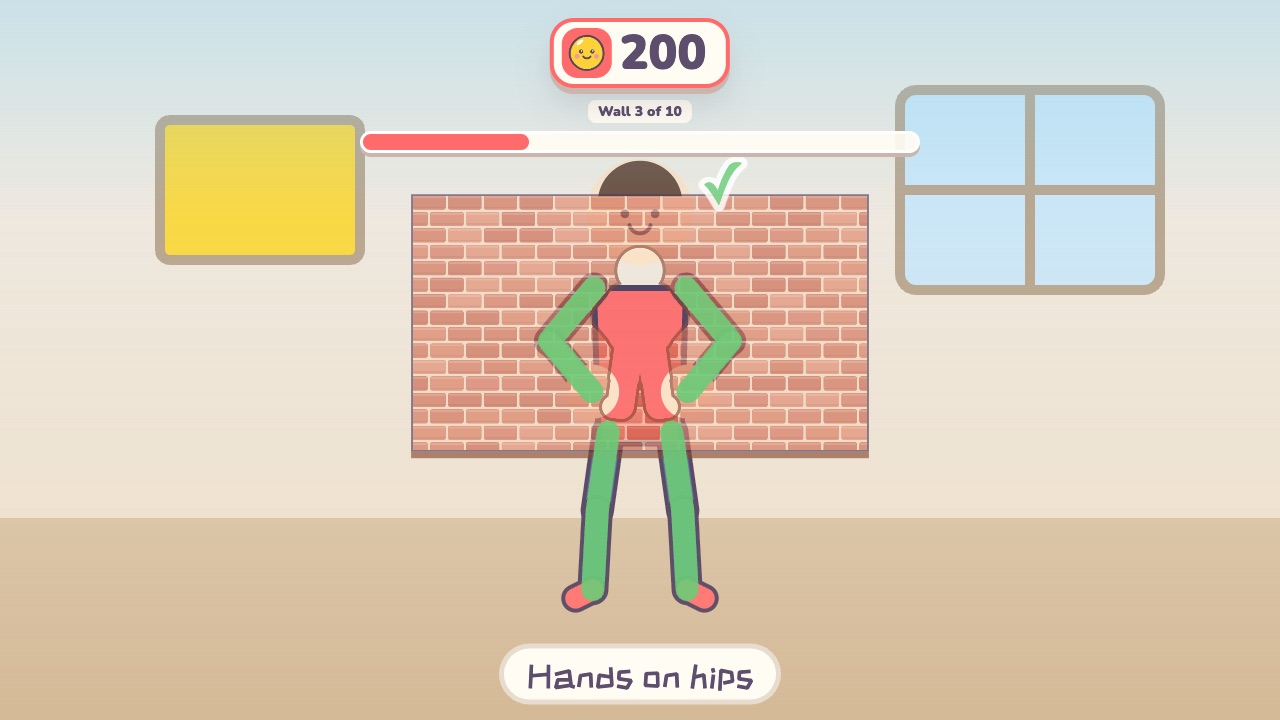 Shape WallMake the same shape as the hole in the wallAges 4–12 · Moderate activity · Whole body / Thinking
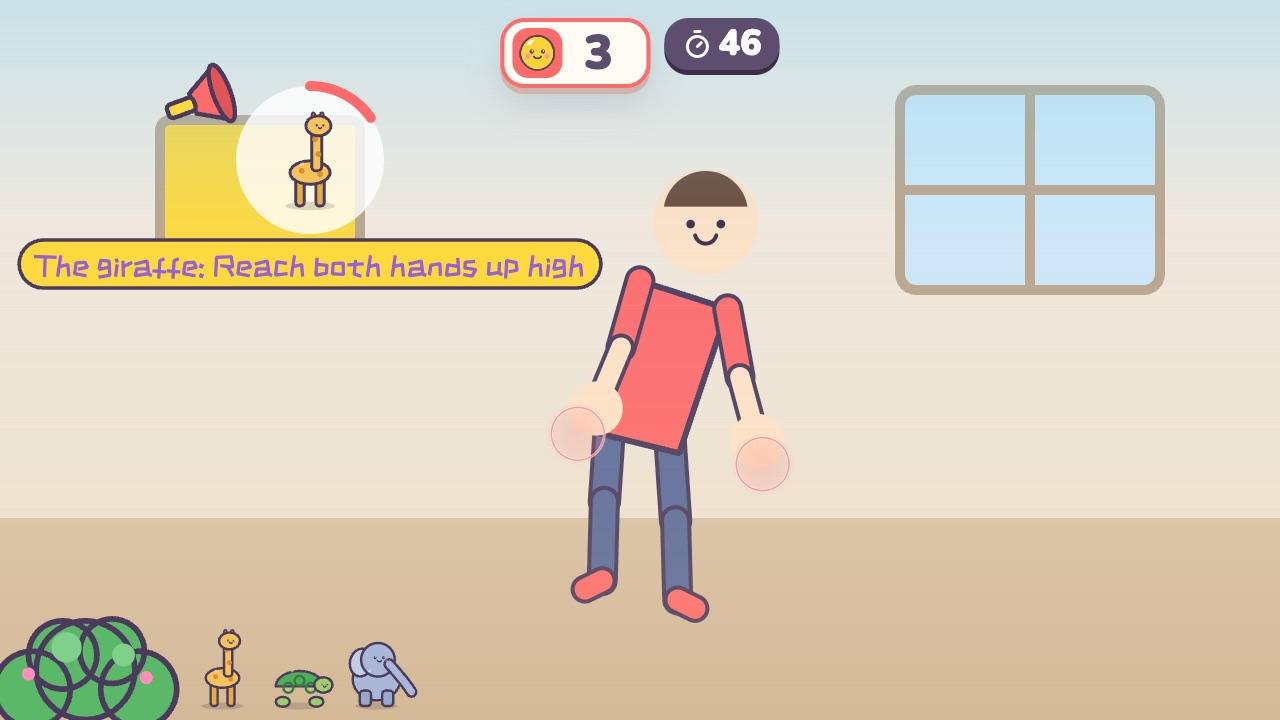 Animal MovesDo the move of whichever animal gets calledAges 3–8 · Moderate activity · Whole body
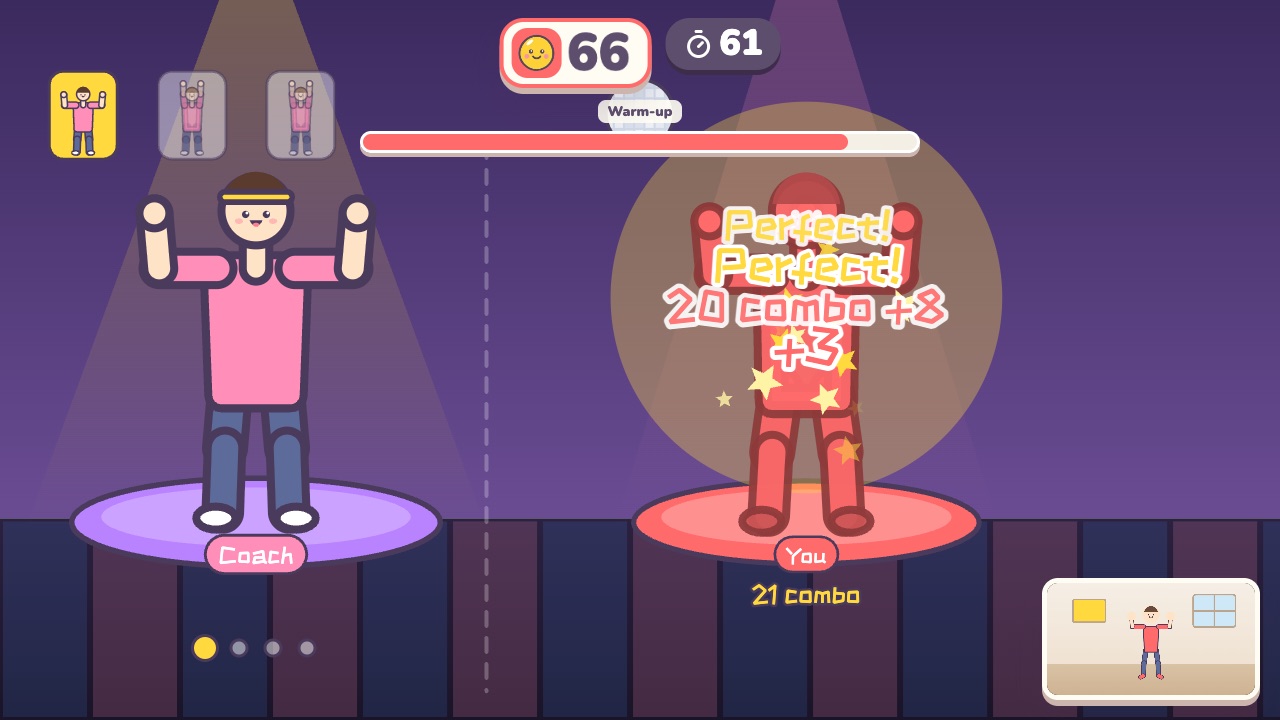 Dance AlongDance with the coach. Every beat is scored on how well you match the moveAges 12–18 · High activity · Rhythm / Whole body
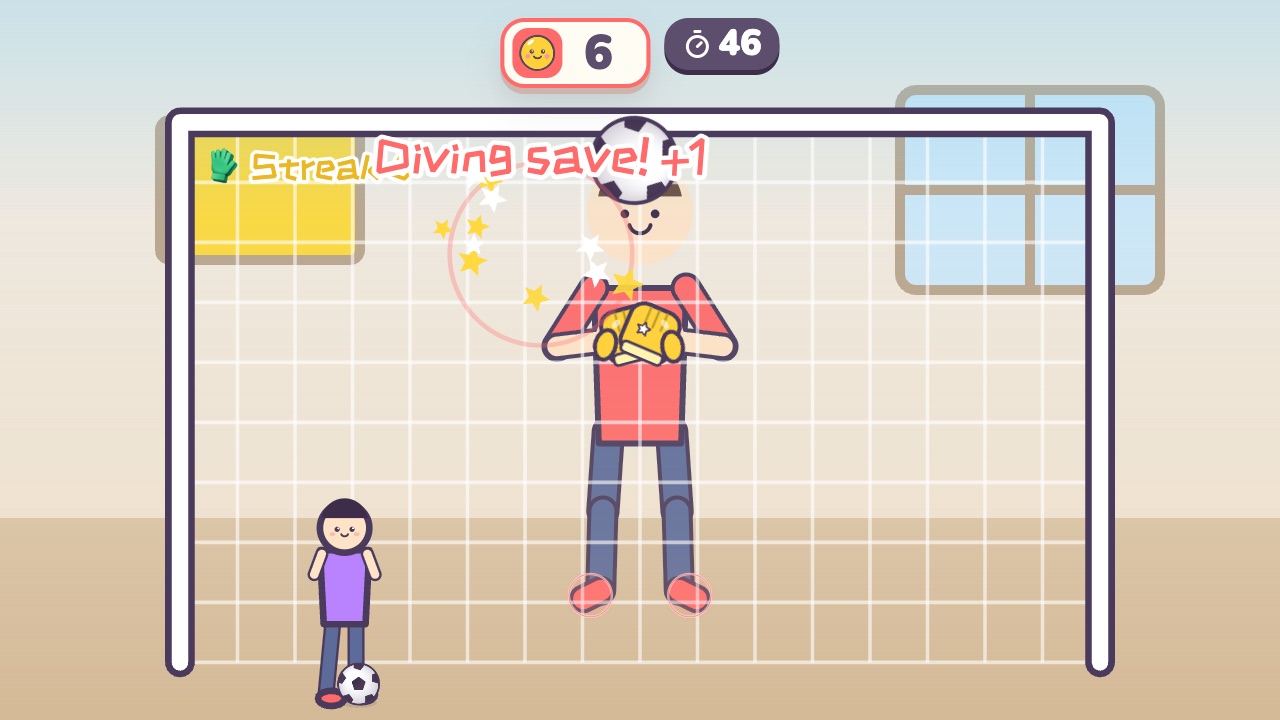 GoalkeeperUse your hands, feet and head to keep the shots out of the goalAges 9–16 · High activity · Whole body / Hands / Run & jump

Real footage · 14 s
Kids stand in front of the computer and just move
100+ motion games for ages 3 to 18. Open the website and play: nothing to install, and the camera picture stays on this computer.
Sources
- PrimeSense Supplies 3-D-Sensing Technology to “Project Natal” for Xbox 360. Microsoft News Center. March 31, 2010: the sensor is based on a PrimeSense reference design
- Kinect for Xbox 360 North American launch (press release). Microsoft PressPass (Internet Archive copy). November 4, 2010; $149.99 on its own
- Kinect sells 1 million in 10 days (press release). Microsoft PressPass (Internet Archive copy). November 15, 2010
- Fastest-selling gaming peripheral. Guinness World Records. Kinect for Xbox 360: 133,333 a day on average in its first 60 days
- Real-Time Human Pose Recognition in Parts from Single Depth Images. Shotton et al. (Microsoft Research Cambridge, Xbox Incubation), CVPR 2011. Labels body parts pixel by pixel in a single depth image; under 5 ms per frame on Xbox 360
- Kinect for Windows Sensor Components and Specifications. Microsoft developer documentation. Color camera, infrared emitter and infrared depth sensor, four-microphone array; 57° × 43° field of view
- Xbox One to Launch Nov. 22 in 13 Markets. Official Microsoft Blog. September 2013: every Xbox One includes the new Kinect
- Collaboration, Expertise Produce Enhanced Sensing in Xbox One. Official Microsoft Blog. October 2013: the second-generation Kinect uses a time-of-flight camera
- Delivering More Choices for Fans. Xbox Wire (Internet Archive copy). May 13, 2014: Xbox One without Kinect from June 9, $399
- Exclusive: Microsoft Has Stopped Manufacturing The Kinect. Fast Company (Internet Archive copy). October 25, 2017, confirmed by Microsoft in an interview; the article gives about 35 million sold
- Microsoft at MWC Barcelona: Introducing Microsoft HoloLens 2. Official Microsoft Blog. February 24, 2019: Azure Kinect Developer Kit announced (time-of-flight depth sensor)
- Microsoft’s Azure Kinect Developer Kit Technology Transfers to Partner Ecosystem. Microsoft Mixed Reality Blog (Internet Archive copy). August 17, 2023: production of the Azure Kinect Developer Kit ends