 DongDong Park
Why did motion gaming fade, and where did it go?
Updated
When people say motion gaming has died out, they usually mean motion add-ons for game consoles: Kinect stopped coming with Xbox One in 2014 and was reportedly discontinued in 2017, and earlier devices like the data glove and the infrared ring were gone within about a year. But motion games themselves didn’t disappear. They caught on somewhere else: home fitness, family play, VR, the cameras in phones and computers, and school PE.
Why console motion controls faded
The companies never explained it officially. These are the usual reasons:
- The old add-on problem: bought separately, few games. The 1989 Power Glove worked only with a handful of games written for it, and Kinect, once unbundled in 2014, was in the same spot. Few buyers meant studios didn’t want to make games for it, and few games meant even fewer buyers (see Early devices and Kinect).
- Space. Kinect needed one player to stand about 6 feet (1.8 m) back and two players about 8 feet (2.4 m), and moving around in VR needs about 6.5 by 6.5 feet (2 m × 2 m). Plenty of living rooms don’t have that (see How much space motion games need).
- It’s tiring. Studies of whole-body motion games measure light to moderate intensity: good for a while, not for hours on end (see Do motion games count as exercise?).
- Fast, fine movements are hard. Fingers, quick small moves and hidden body parts are hard for cameras and controllers alike, and for many kinds of games buttons still work better.
- It raised the price. Xbox One with Kinect cost $499.99; without it, $399, or $100 less.
Where it caught on instead
| Direction | Example | Numbers |
|---|---|---|
| Home fitness | Ring Fit Adventure (2019) | 15.38 million by the end of March 2023 (Nintendo) |
| Family play | Nintendo Switch Sports (2022) | 18.32 million by the end of March 2026 (Nintendo) |
| Dance | The Just Dance series (2009 to today) | More than 90 million (Ubisoft, 2024) |
| VR | Beat Saber (2018) | More than 4 million across platforms (Oculus, 2021) |
| Just your body | VR hand tracking (2019), Apple Vision Pro (2024), camera games on phones and computers | No controller: cameras recognize hands and bodies |
| School PE | Dance games in West Virginia PE classes (2006) and exergaming lessons since | Students are more interested; best used alongside regular PE (see Motion games in schools) |
In other words, motion games went from a console’s big selling point to a tool for particular moments: exercise, family time, the classroom. Not every game has to use motion; motion games fit wherever people need to get moving.
Why it was so popular in the first place
- Easy to start. The movement is the control, so even people who never play games can join in right away.
- Fun to watch together. Other people’s moves are entertaining in themselves, which suits family get-togethers and friendly matches.
- It gets people moving. With parents worried that kids always sit still to play games, motion games offered another option.
- It came standard. Every Wii came with a motion controller, Wii Sports was in the box in most regions, and the Wii sold more than 100 million consoles (see The Wii).
Where it’s heading
Going by what has already happened, a few directions are clear:
- Nothing to hold. From Kinect’s depth camera to VR hand tracking to pose recognition with an ordinary camera, the device keeps getting more invisible (see Webcams and the browser).
- No new hardware. The cameras already on phones, computers and TVs are enough.
- Into classrooms. As a supplement to PE: indoor days, warm-ups and brain breaks (see the classroom guide).
- More attention to privacy. With a camera pointed at children, where the picture is processed and whether it is kept matter more and more.
Common questions
Why did motion gaming die out?
What faded was mostly console motion add-ons: they had to be bought separately and had few games of their own, needed space, were tiring, struggled with fast, fine movements and raised the price of the console. Kinect stopped being bundled in 2014 and was reportedly discontinued in 2017. But motion games moved into fitness, family play, VR and school PE, and Ring Fit, Switch Sports and Just Dance have each sold more than 10 million copies.
Do people still play motion games?
Yes. Nintendo Switch Sports had sold 18.32 million copies by the end of March 2026, Ring Fit Adventure 15.38 million by the end of March 2023, and the Just Dance series more than 90 million in total. VR and camera games on phones and computers are where things are going now.
Does motion gaming have a future?
Judging by what has already happened: the devices keep getting more invisible (hand tracking, ordinary cameras), you don’t need to buy new hardware, and schools use motion games alongside PE. Privacy and safe movement matter more than ever along the way.
Why was motion gaming so popular?
It is easy to start because the movement is the control, it is fun with a group, and it gets kids moving. And in 2006 the Wii made a motion controller standard equipment; the console sold more than 100 million units.
More in “The history of motion games, from light guns to webcams”
- The history of motion games, from light guns to webcams (overview)
- What was the first motion game?
- Before the Wii: balance boards, mats, gloves and dance pads (1982–2004)
- EyeToy (2003): the camera comes to the living room
- The Wii (2006): motion controls for the whole family
- Kinect (2010): nothing to hold, and why it was discontinued
- PlayStation Move, Switch and Ring Fit: motion games turn to fitness
- Motion games in VR: from room-scale tracking to Beat Saber
- Motion games in schools: from DDR in PE class to today
- Webcams and the browser: motion games without special hardware
Games mentioned here
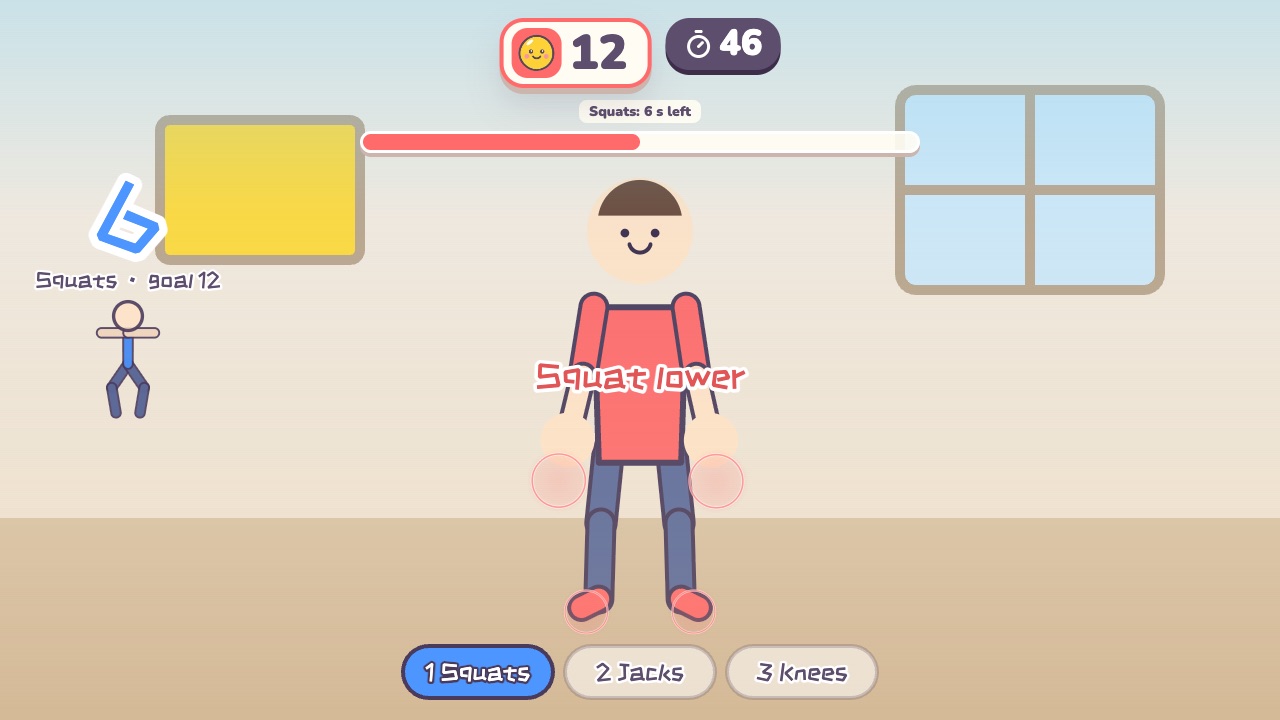 Fitness CircuitSquats, jumping jacks and high knees: three stations, counted for youAges 12–18 · High activity · Fitness / Run & jump / Whole body
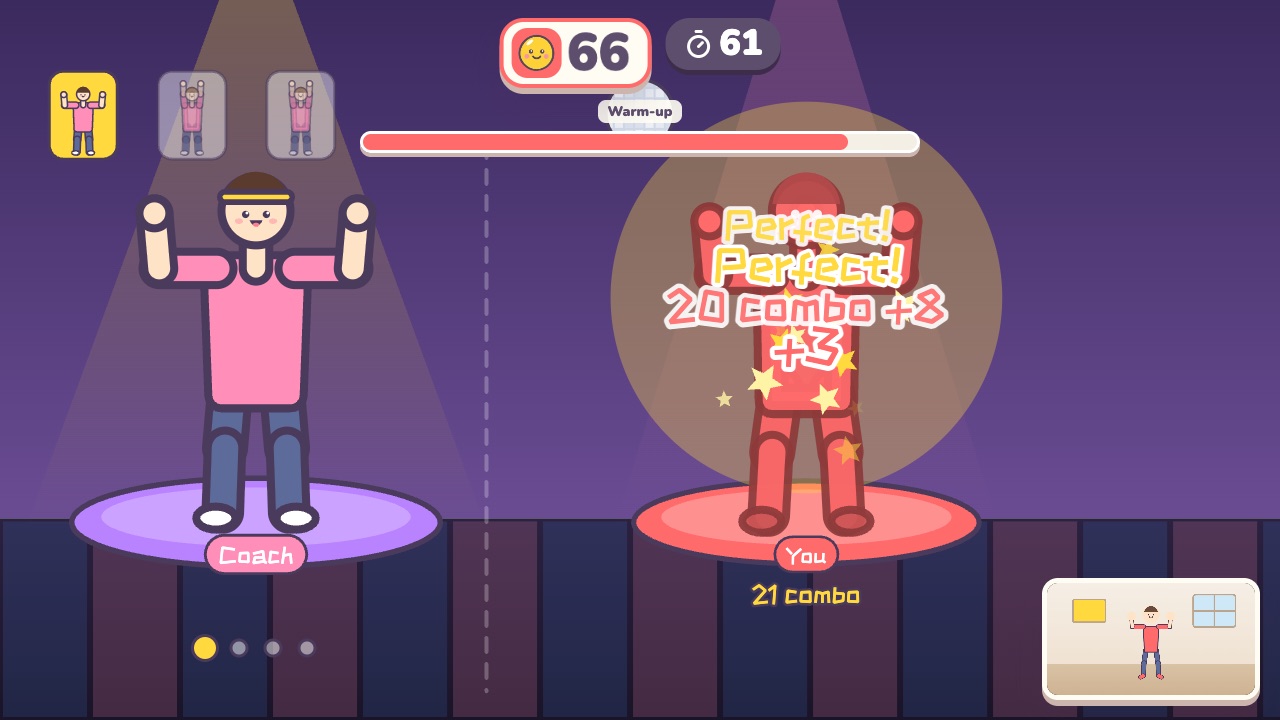 Dance AlongDance with the coach. Every beat is scored on how well you match the moveAges 12–18 · High activity · Rhythm / Whole body
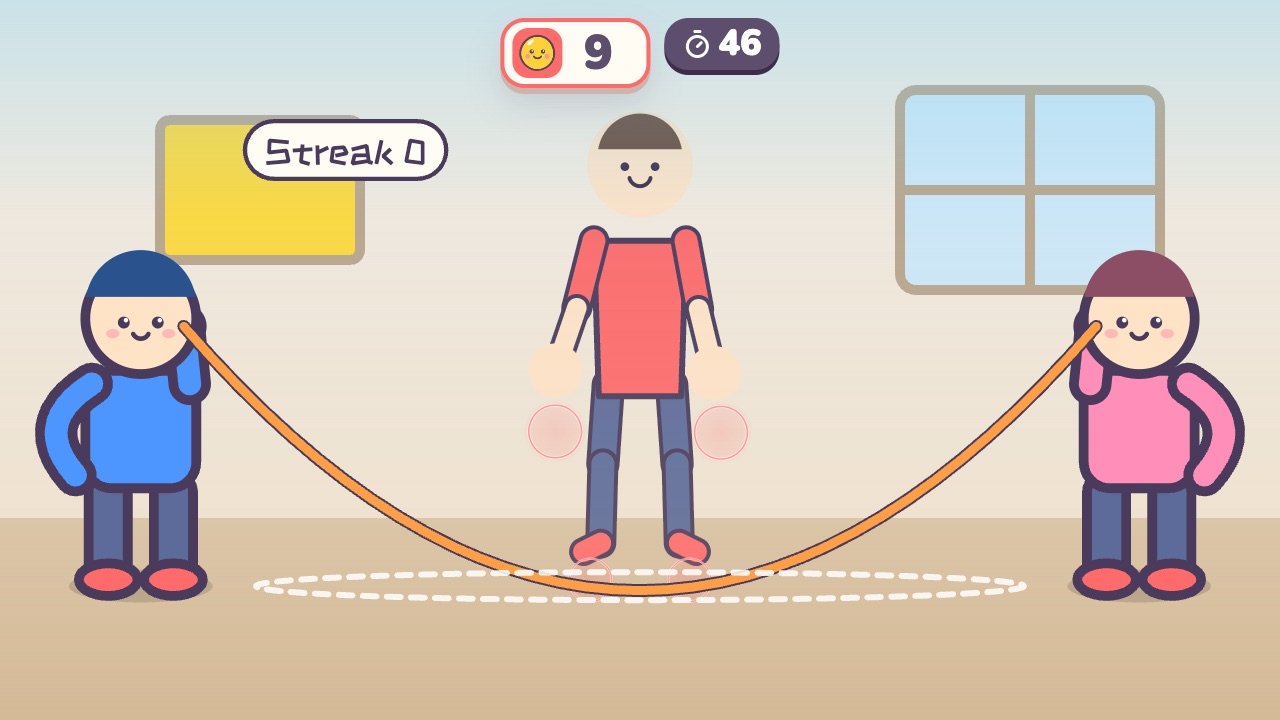 Jump Rope ChampJump when the rope sweeps under your feet. The longer your streak, the faster the ropeAges 6–14 · High activity · Run & jump / Fitness / Rhythm
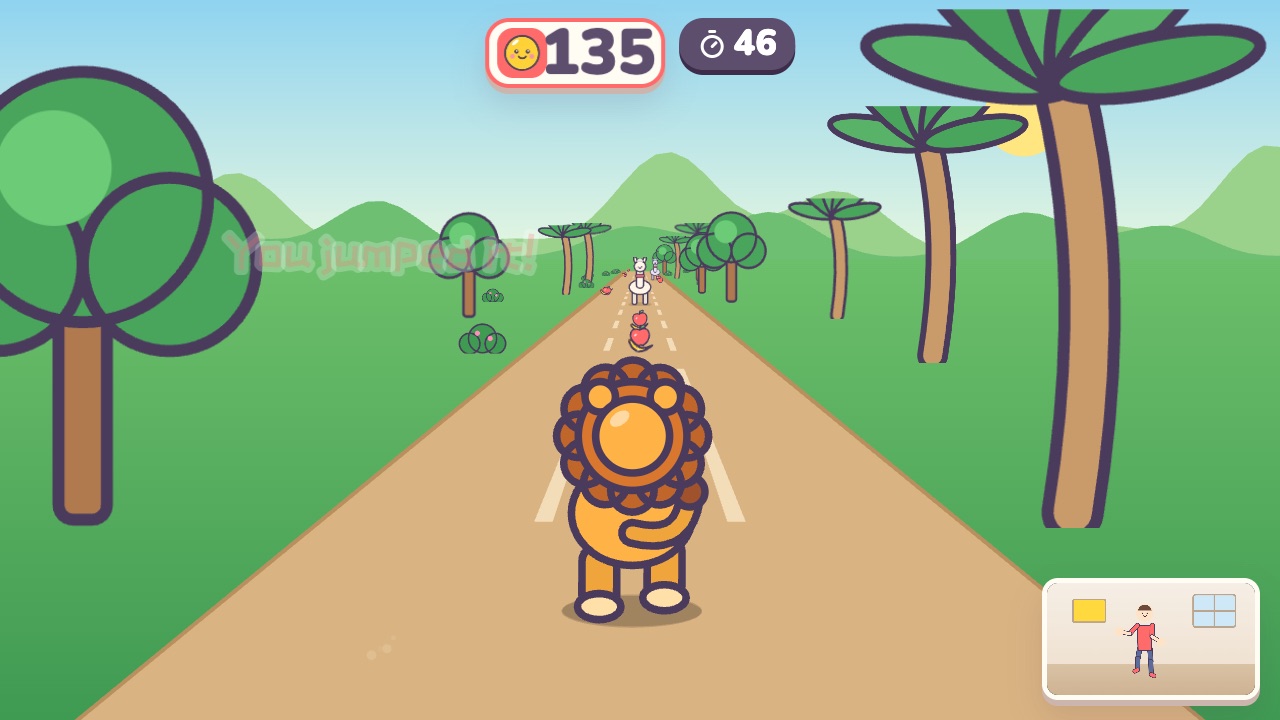 Forest RunRun on the spot, dodge left and right, and jump over the logsAges 4–10 · High activity · Run & jump / Whole body
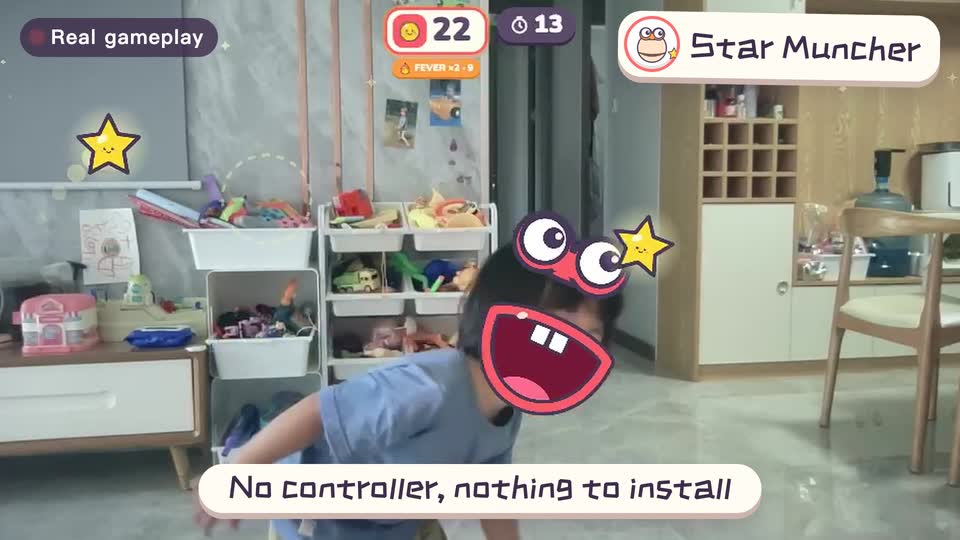
Real footage · 14 s
Kids stand in front of the computer and just move
100+ motion games for ages 3 to 18. Open the website and play: nothing to install, and the camera picture stays on this computer.
Sources
- Delivering More Choices for Fans. Xbox Wire (Internet Archive copy). May 13, 2014: Xbox One without Kinect from June 9, $399
- Exclusive: Microsoft Has Stopped Manufacturing The Kinect. Fast Company (Internet Archive copy). October 25, 2017, confirmed by Microsoft in an interview; the article gives about 35 million sold
- Microsoft’s Azure Kinect Developer Kit Technology Transfers to Partner Ecosystem. Microsoft Mixed Reality Blog (Internet Archive copy). August 17, 2023: production of the Azure Kinect Developer Kit ends
- Nintendo NES Power Glove. Australian Centre for the Moving Image (ACMI). Released October 1989; developed by Abrams/Gentile Entertainment and Mattel
- Set up your boundary for Meta Quest. Meta. At least 2 m × 2 m recommended for moving around; 1 m × 1 m by default for stationary play
- Financial results explanatory material, fiscal year ended March 2023 (million-seller titles). Nintendo Investor Relations. As of March 31, 2023: Ring Fit Adventure 15.38 million
- Financial results explanatory material, fiscal year ended March 2026 (million-seller titles). Nintendo Investor Relations. As of March 31, 2026: Nintendo Switch Sports 18.32 million; Switch 2 launched June 5, 2025
- Dedicated Video Game Sales Units. Nintendo Investor Relations. As of September 30, 2026: Wii 101.63 million, Switch 157.20 million, Switch 2 26.35 million
- Just Dance Celebrates 15th Anniversary. Ubisoft. November 2024: the first game came out November 17, 2009; over 90 million sold across the series
- From Bear to Bull: How Oculus Quest 2 Is Changing the Game for VR. Oculus Blog (Internet Archive copy). February 2021: Beat Saber has sold over 4 million copies across platforms
- Thumbs Up: Hand Tracking on Oculus Quest This Week. Oculus Blog (Internet Archive copy). Hand tracking as an experimental feature from December 2019
- Introducing Apple Vision Pro (Chinese edition). Apple Newsroom. June 5, 2023: controlled with eyes, hands and voice
- Konami Digital Entertainment and the State of West Virginia Develop Groundbreaking Program. Konami (official press release, Internet Archive copy). January 25, 2006: a three-year partnership bringing the dance game into PE or health classes in the state’s public schools