 DongDong Park
What was the first motion game?
Updated
There is no single answer to “what was the first motion game?” It depends on what you count. Using your body to interact with a computer picture goes back to the 1970s interactive art of the American artist Myron Krueger. Commercial motion play starts with Nintendo’s 1973 Laser Clay Shooting System and its 1984 light gun. The first machines called “taikan games” (the word still used in Japanese and Chinese for motion games) were big Sega arcade cabinets such as Hang-On, around 1985.
Three ways to count, three answers
| What counts | Answer | Year | How it sensed the body |
|---|---|---|---|
| Using your body to interact with a computer picture | Krueger’s PSYCHIC SPACE and VIDEOPLACE (interactive art) | 1971, 1975 | A floor of pressure switches; a video camera capturing the person’s outline |
| Commercial motion play | Nintendo’s Laser Clay Shooting System; the Famicom light gun and Duck Hunt | 1973; 1984 | A light sensor in the gun |
| Called a “taikan game” | Sega’s Hang-On, Space Harrier, Out Run and other arcade cabinets | 1985–1986 | The player leans the machine, and the cabinet detects the tilt |
The 1970s: Krueger’s “artificial reality”
The American computer artist Myron Krueger built a series of “responsive environments” at the University of Wisconsin. In PSYCHIC SPACE, shown in May and June 1971, the floor was a grid of pressure switches about 16 by 24 feet (roughly 5 × 7 m), so the computer knew where people were walking. They could play the floor like a keyboard or walk through a projected maze.
Better known is VIDEOPLACE. According to Krueger’s 1977 paper, its first version was shown for six weeks at the Milwaukee Art Center from October 1975. A video camera filmed people against a plain background, and the computer digitized their outlines, then checked whether an outline touched another person’s image or a shape on the screen. Participants wore nothing: they used their whole body to interact with the computer. Krueger says he conceived the work in 1969, and in 1990 it won the first Golden Nica for Interactive Art at Prix Ars Electronica in Austria.
In today’s terms, VIDEOPLACE was already a camera motion game: nothing to hold, just a camera watching people. But it was an art installation in a gallery, not a game you could take home.
1973–1984: the light gun
Nintendo’s official company history lists the 1973 development of a commercial entertainment system, the Laser Clay Shooting System. It was reportedly developed by Gunpei Yokoi and turned bowling alleys into virtual clay-pigeon shooting ranges. The first ones opened in spring 1973 to a lot of attention, but the oil crisis that followed brought a wave of canceled orders.
A decade later the light gun came home. On February 18, 1984, Nintendo released the Famicom light gun with Wild Gunman, and on April 21 it released Duck Hunt; when the NES launched in North America in 1985, the gun and Duck Hunt came along. The gun sends nothing out. According to Nintendo’s patent, the instant you pull the trigger the screen shows one black frame, then a white box where the target is, and a phototransistor in the gun “sees” that white box, which counts as a hit. That is why aiming at a light bulb doesn’t fool it.
A light gun only knows where the barrel points, not how the player moves. Still, raising it, aiming and pulling the trigger was already a way of playing with your body.
1985–1986: the word “taikan game” appears
On July 5, 1985, Sega released the arcade game Hang-On. According to the trade magazine Game Machine at the time, players sat on a motorbike-shaped cabinet and leaned it into corners by shifting their weight, up to 12 degrees each way, while the bike on screen tilted with them. Sega’s advertising said players could pull off riding techniques with their whole body.
The word taikan (体感, “felt with the body”) had appeared by that December in Sega’s ads for Space Harrier: the ad said the cockpit moved, called it “taikan shooting,” and explained that as a shooting sensation you feel with your body. When Sega presented Out Run in 1986, it called it the culmination of its series of taikan games played with the whole body, and reports from the time used the term for other companies’ similar machines too. By late 1986, “taikan game” was a category name in the Japanese arcade business. Hang-On was later named, looking back, as the first taikan game.
In the 1980s, a “taikan game” meant a big moving arcade machine you could ride, and the point was feeling the motion with your body. Today’s motion games are about a device sensing how your body moves. The two are related, but not the same thing.
What came next
From the 1980s to the early 2000s, floor mats, a data glove, infrared panels, dance machines and tilt-sensing cartridges came and mostly went: see the next chapter. Cameras didn’t really reach the living room until EyeToy in 2003.
Common questions
What was the first motion game?
It depends how you count. Interacting with a computer picture using your body goes back to Krueger’s 1970s interactive art, VIDEOPLACE. Commercial motion play starts with Nintendo’s 1973 Laser Clay Shooting System and the 1984 light gun and Duck Hunt. The first machines called “taikan games” were Sega’s big arcade cabinets such as Hang-On, from 1985.
When did motion games start?
Art installations that let people interact with a computer through their bodies existed in the 1970s; commercial light-gun shooting arrived in 1973; Japanese arcades started using the term “taikan game” around 1985; and the 2006 Wii brought motion games into homes on a large scale.
Where did motion gaming come from?
The idea of interacting with a computer through your body came from American interactive art (Krueger’s VIDEOPLACE). The commercial light gun came from Nintendo in Japan, and the word “taikan game” from Sega’s arcade machines in 1980s Japan.
What was the first motion-control console?
Before the 2006 Nintendo Wii, motion play mostly came as add-ons: light guns, balance boards and dance mats in the 1980s, and the EyeToy camera in 2003. The Wii made a motion controller the console’s standard controller, and that is when motion consoles took off.
More in “The history of motion games, from light guns to webcams”
- The history of motion games, from light guns to webcams (overview)
- Before the Wii: balance boards, mats, gloves and dance pads (1982–2004)
- EyeToy (2003): the camera comes to the living room
- The Wii (2006): motion controls for the whole family
- Kinect (2010): nothing to hold, and why it was discontinued
- PlayStation Move, Switch and Ring Fit: motion games turn to fitness
- Motion games in VR: from room-scale tracking to Beat Saber
- Motion games in schools: from DDR in PE class to today
- Webcams and the browser: motion games without special hardware
- Why did motion gaming fade, and where did it go?
Games mentioned here
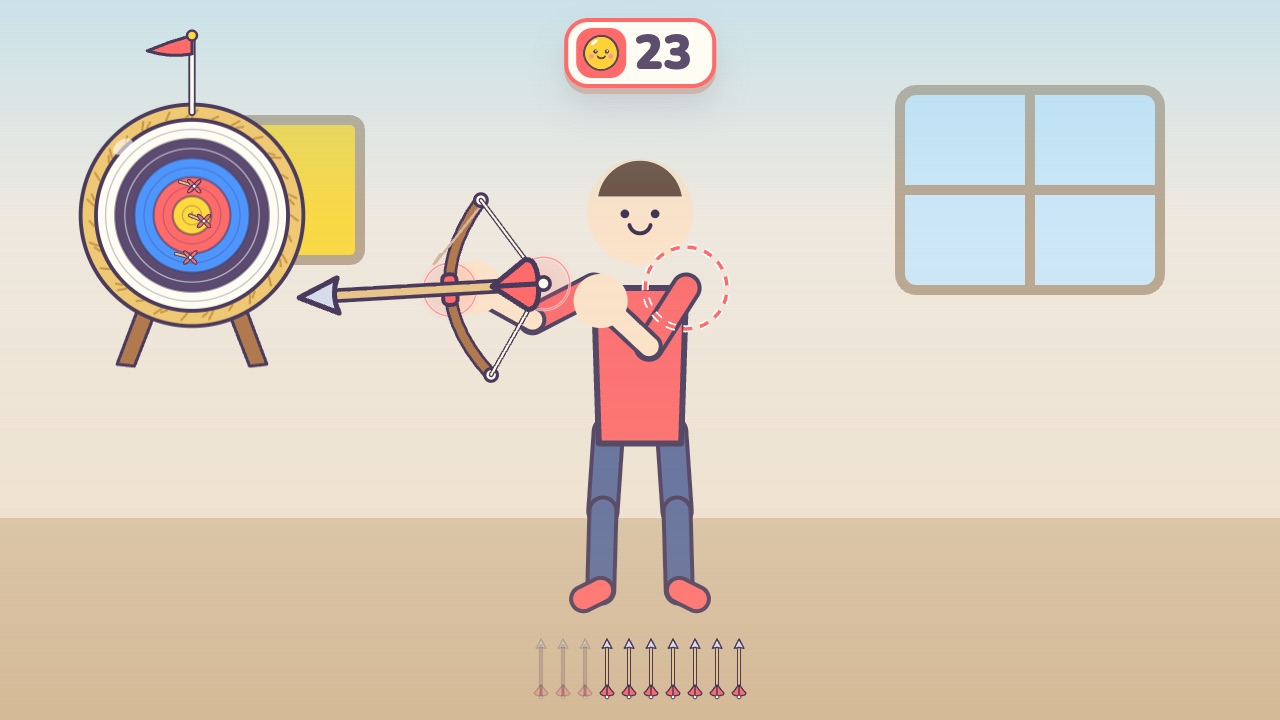 ArcheryOne arm is the bow, the other pulls the string. Hold steady, then let it flyAges 8–18 · Light activity · Hands / Calm
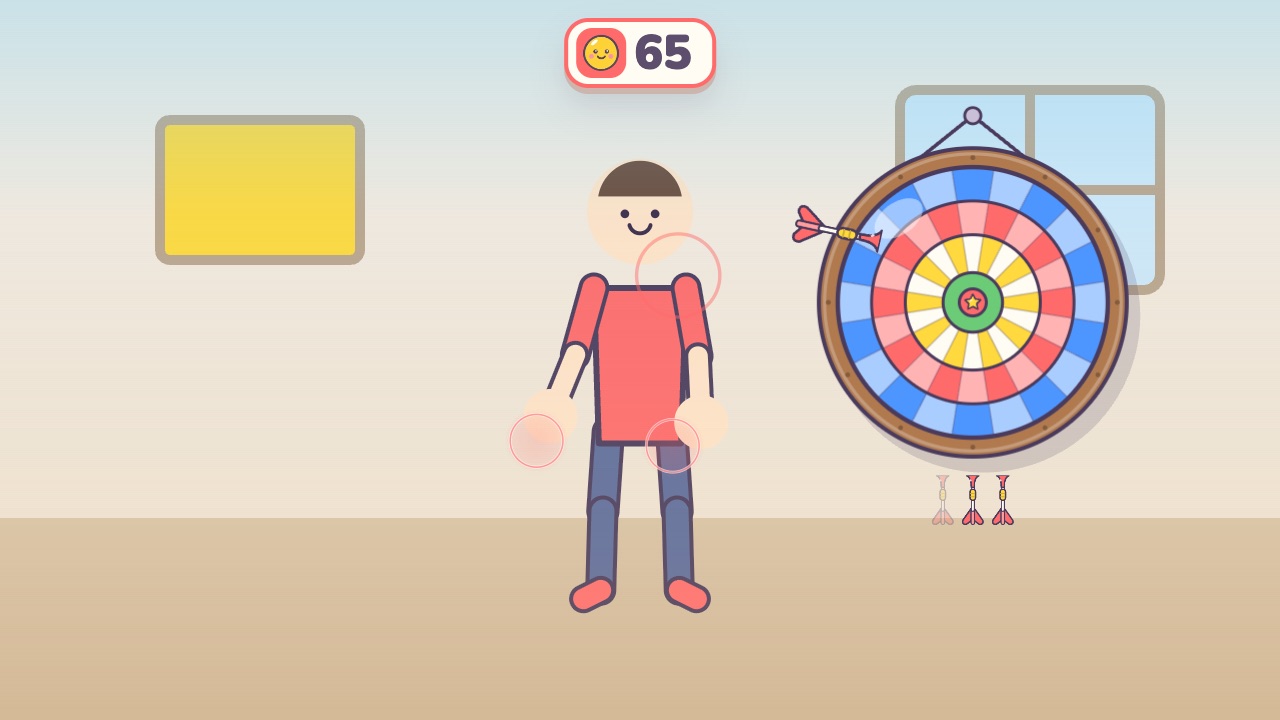 DartsRaise your hand by your ear and flick it forward to throw a dartAges 8–18 · Light activity · Hands / Calm
 Slalom SkiLean left and right to ski through the flag gatesAges 5–10 · Moderate activity · Whole body
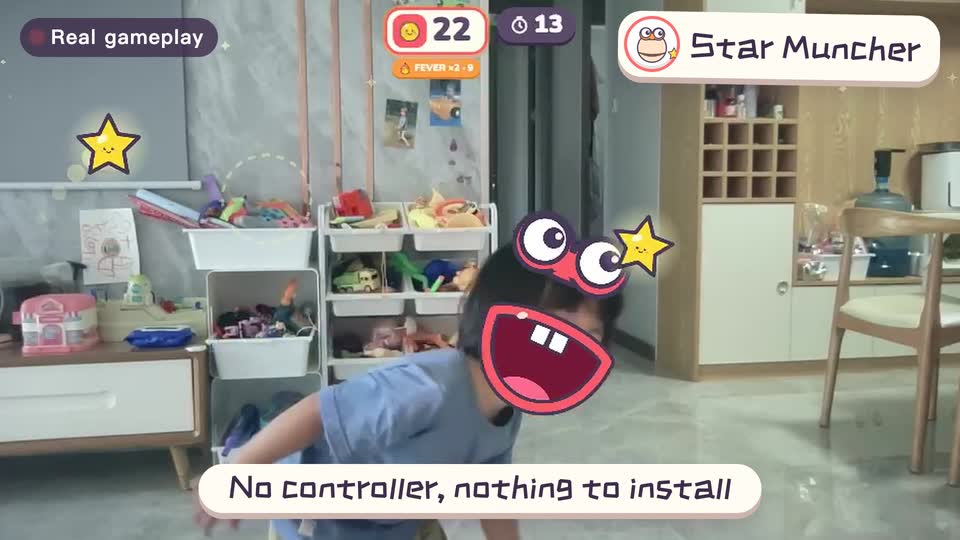
Real footage · 14 s
Kids stand in front of the computer and just move
100+ motion games for ages 3 to 18. Open the website and play: nothing to install, and the camera picture stays on this computer.
Sources
- Responsive Environments. Myron W. Krueger, AFIPS National Computer Conference Proceedings, vol. 46. 1977; the first VIDEOPLACE was shown for six weeks at the Milwaukee Art Center from October 1975; PSYCHIC SPACE (1971) sensed people with a floor of pressure switches
- VIDEOPLACE (Ars Electronica 1999 artist statement). Myron Krueger, Ars Electronica archive. Conceived in 1969, simulated in 1970; first Golden Nica for Interactive Art in 1990
- Company history (会社の沿革). Nintendo (Japanese site). 1973: develops the commercial Laser Clay Shooting System
- Family Computer history (ファミリーコンピュータ ヒストリー). Nintendo (Japanese site). Light gun released February 18, 1984; Duck Hunt April 21, 1984
- US Patent 4,813,682 (light-gun hit detection). Nintendo; inventor Satoshi Okada. Priority date August 1985: one black frame, then a white box at the target; a phototransistor in the gun detects the white light as a hit
- Game Machine (ゲームマシン), no. 265. Japanese arcade-industry trade magazine. August 1, 1985: in Hang-On, players shift their weight to lean the bike, up to 12 degrees each way
- Game Machine (ゲームマシン), no. 274. Japanese arcade-industry trade magazine. December 15, 1985: Sega’s Space Harrier ad calls it “taikan shooting,” a shooting sensation felt with the body
- Game Machine (ゲームマシン), no. 295. Japanese arcade-industry trade magazine. November 1, 1986: Sega calls Out Run the culmination of its taikan game series