 DongDong Park
Motion gaming glossary
Updated
The terms you meet in motion game manuals, articles and research, in three groups: games and play, devices and how they work, and exercise and health. Each one in a sentence or two.
Games and play
- Motion game (motion-controlled game)
- A video game you control with body movement: a device senses the movement and the game responds right away. See what is a motion game?
- Motion control, motion sensing
- Using body movement to “talk” to a machine. Games are the best-known use; museum exhibits, fitness mirrors and smart TVs use it too.
- Exergame
- Exercise + game: a video game where playing is itself physical activity, such as dancing, boxing or jump rope.
- Active video game
- Another name for an exergame. Along with “exergame”, it is the term research papers use most.
- Fitness game
- An exergame designed for working out, with training plans, rep counting and intensity cues.
- Light-gun game
- A game where you aim a light gun at the screen and shoot: one of the earliest ways of playing with your body. See what was the first motion game?
- Somatosensory game, body-sensing game (taikan)
- Literal translations of the Chinese and Japanese word for motion games, 体感 (taikan, “body sensation”). Sega used taikan game in the mid-1980s for its big arcade cabinets that moved as you played.
- VR, AR, MR
- Virtual reality (a headset shows a virtual world), augmented reality (virtual things added to the real picture) and mixed reality (the two combined). See motion games vs VR vs AR.
Devices and how they work
- Sensor
- A part that turns something physical, such as temperature, pressure, motion or light, into data. Motion devices commonly use accelerometers, gyroscopes, pressure sensors, infrared sensors and cameras.
- Accelerometer
- A sensor that measures which way something is accelerating, and also which way is down (the pull of gravity). It is what rotates a phone screen and counts steps.
- Gyroscope
- A sensor that measures how fast and how far something turns. Paired with an accelerometer, it measures a controller’s rotation more precisely.
- Infrared (IR)
- Light the human eye can’t see. Motion devices use infrared lights and infrared cameras for tracking because they aren’t thrown off by the color of the room lighting.
- Depth camera
- A camera that measures how far away each point in the picture is. The two common methods are structured light and time of flight.
- Structured light
- Projecting a pattern of infrared dots into a scene and working out distance from how the pattern bends.
- Time of flight (ToF)
- Working out distance from how long light takes to travel out and bounce back.
- Motion capture (mocap)
- Recording a person’s movement as data. Professional motion capture for films and animation puts markers on the body and surrounds it with cameras; motion games use a simplified, real-time version.
- Pose estimation (pose recognition)
- Finding a person in a picture, along with where body parts such as the head, shoulders, hands and feet are, and so working out what pose they are in.
- Skeletal tracking
- Joining the recognized body parts into a stick-figure “skeleton” and following it frame by frame as the person moves.
- Gesture recognition
- Recognizing hand shapes and hand movements: an open hand, a fist, fingers showing a number, a wave.
- Latency (delay)
- The time from a move to a reaction on screen. The shorter it is, the more responsive the game feels; rhythm games care about it most.
- Frame rate (fps)
- How many pictures are processed each second. The higher it is, the less likely a fast move is missed.
- Field of view
- How wide an area a camera can see. With a narrow field of view you have to stand farther back to fit in the picture. See how much space motion games need.
Exercise and health
- MET (metabolic equivalent of task)
- A unit of exercise intensity: sitting quietly is 1, and the higher the number, the harder the activity. Roughly, 3 to 6 is moderate and above 6 is vigorous. See do motion games count as exercise?
- Moderate-to-vigorous physical activity (MVPA)
- Activity that clearly speeds up your heart and your breathing. The World Health Organization recommends that children aged 5 to 17 get at least 60 minutes a day on average. See how much exercise kids need.
- Sedentary behavior, screen time
- Time spent sitting or lying down using very little energy; sitting still in front of a screen is the most common kind. Motion games played standing up and moving involve a screen but are not sedentary. See are motion games bad for kids’ eyes?
- Fundamental movement skills
- Running, jumping, throwing, catching, kicking and balancing: the building blocks for learning any sport later on.
- Executive function
- The self-management skills: focusing, holding back impulses, keeping rules in mind and switching flexibly between tasks. See motion games and attention.
More in “What is a motion game?”
- What is a motion game? (overview)
- Types of motion games, with examples
- How motion games work: from light guns to webcams
- Motion games, VR and AR: what’s the difference?
- How much space do motion games need, and how far back should you stand?
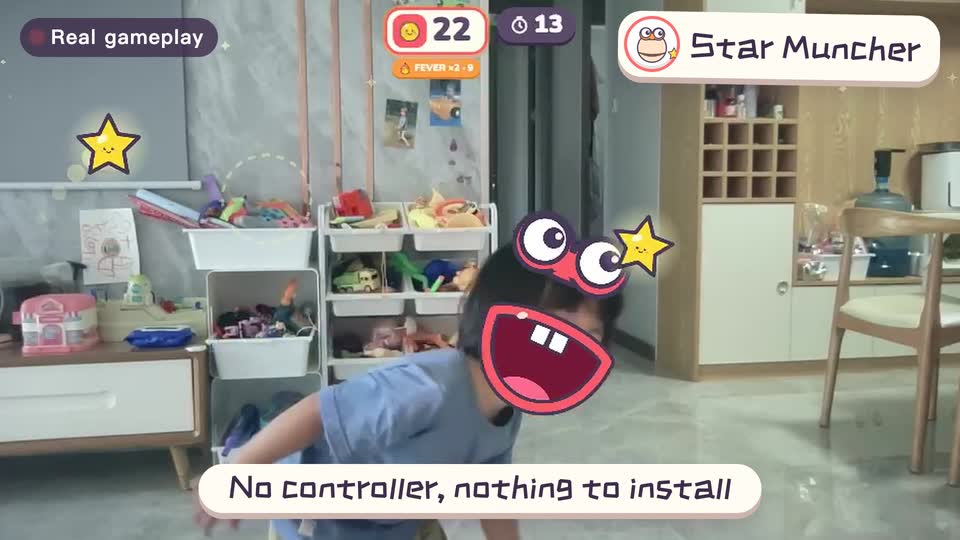
Real footage · 14 s
Kids stand in front of the computer and just move
100+ motion games for ages 3 to 18. Open the website and play: nothing to install, and the camera picture stays on this computer.