 DongDong Park
Can motion games help kids lose weight? Weight, fitness and daily activity
Updated
Don’t count on them for weight loss. Analyses that include only randomized controlled trials find that kids in motion-game programs end up with a slightly lower BMI on average than kids with no program, but the effect is small and the evidence is low quality. Results for kids’ everyday activity are mixed. Motion games work best as an extra alongside other physical activity.
Weight and BMI
- A 2020 meta-analysis (12 randomized controlled trials): compared with no program or a minimal one, motion games brought a small drop in BMI in the short and medium term, but did no better at raising activity levels.
- The newest, from 2026 (14 randomized controlled trials, 942 kids aged 4 to 18): a small but significant drop in BMI and a slight drop in systolic blood pressure, with no significant change in diastolic pressure, blood lipids or blood sugar. The authors rated the evidence for BMI as “low” and for most cardiometabolic measures as “very low”.
- Kids with overweight or obesity (2021, 15 papers): positive effects on BMI and body fat percentage, and cardiorespiratory fitness also seemed to improve; the effects on muscle strength, waist size and motor skills are unclear.
- Kids at a healthy weight (2021, 20 papers): BMI changed only in programs longer than 18 weeks; cardiorespiratory fitness improved.
Do they make kids more active day to day?
This is what parents care about most, and where the evidence is weakest. A 2013 review of 51 studies found that motion games bring light to moderate activity while kids play, but that there is “not enough evidence to recommend them as a way to increase daily physical activity”. A 2025 umbrella review found that only about 23% of programs still showed an effect after they ended.
Which games work better?
A 2022 network meta-analysis compared different kinds of motion games, and rhythm and dance games ranked as the most likely to lower BMI. That fits the intensity data: whole-body, continuous, rhythmic games give more exercise. Try Dance Along or Rhythm Steps.
Advice for parents
- Weight comes down mostly to food and total daily activity; motion games just cut down a little of the sitting time.
- Give them a set slot (15 minutes after dinner, indoor recess on rainy days). That sticks better than playing whenever someone remembers.
- Pair them with real exercise such as running and jumping rope. Jump Rope Champ is a fun warm-up for the real rope.
- For questions about your child’s weight, follow the advice of your pediatrician or a registered dietitian.
Common questions
Can motion games help kids lose weight?
Don’t count on it. Pooled randomized controlled trials show only a small drop in BMI, and the evidence is low quality; kids’ everyday activity didn’t rise consistently either. They work best as an extra alongside other physical activity.
Which motion games are best for weight?
In a 2022 network meta-analysis, rhythm and dance games ranked as the most likely to help. Whole-body, continuous, rhythmic games give more exercise.
Do motion games help kids with overweight or obesity?
A meta-analysis of studies in kids with overweight or obesity found small positive effects on BMI and body fat, and fitness also seemed to improve. Study quality varies, and motion games are no substitute for weight management guided by a doctor.
More in “Are motion games good for kids? Benefits, risks and what the research says”
- Are motion games good for kids? Benefits, risks and what the research says (overview)
- Do motion games count as exercise? Intensity by game type and age
- Why are motion games so tiring? What’s normal and how to stay safe
- Can motion games build motor skills and balance?
- Motion games and focus: what the executive function research shows
- Are motion games bad for kids’ eyes? Screen time, myopia and outdoor play
- Motion games in special education: what the research says
Games mentioned here
 Dance AlongDance with the coach. Every beat is scored on how well you match the moveAges 12–18 · High activity · Rhythm / Whole body
 Rhythm StepsFollow the beat: step left, step right, jump and squatAges 6–16 · High activity · Rhythm / Whole body / Run & jump
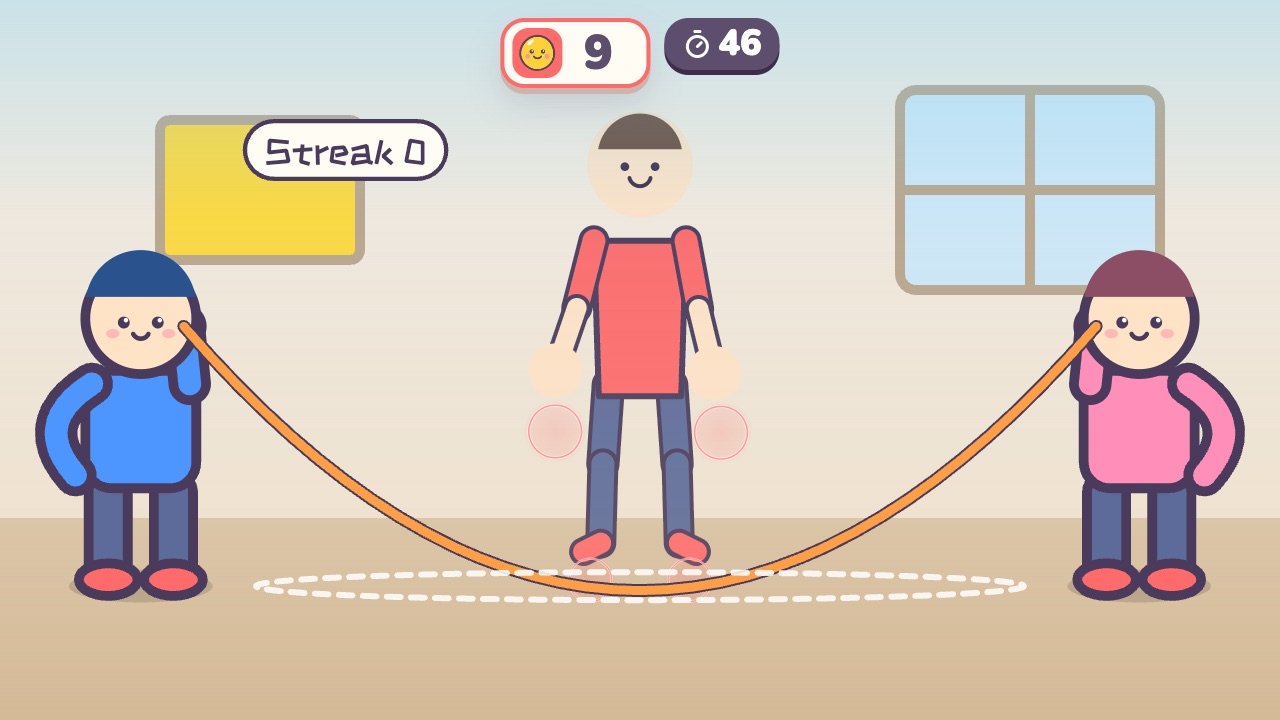 Jump Rope ChampJump when the rope sweeps under your feet. The longer your streak, the faster the ropeAges 6–14 · High activity · Run & jump / Fitness / Rhythm
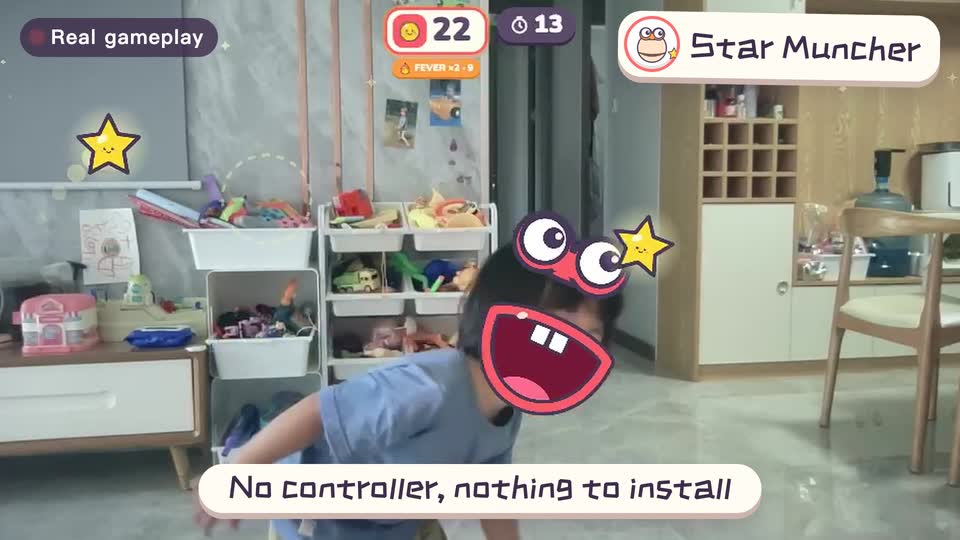
Real footage · 14 s
Kids stand in front of the computer and just move
100+ motion games for ages 3 to 18. Open the website and play: nothing to install, and the camera picture stays on this computer.
Sources
- Effects of Active Video Games on Children and Adolescents: A Systematic Review with Meta-analysis. Oliveira et al., Scandinavian Journal of Medicine & Science in Sports. 2020; randomized controlled trials only (12)
- Effects of Active Video Games on Cardiometabolic Health in Children and Adolescents: Systematic Review and Meta-Analysis of Randomized Controlled Trials. Liu et al., JMIR Serious Games. 2026; 14 randomized controlled trials, 942 children and teens aged 4 to 18
- Effects of Active Video Games on Health-Related Physical Fitness and Motor Competence in Children and Adolescents With Overweight or Obesity. Comeras-Chueca et al., JMIR Serious Games. 2021 systematic review and meta-analysis, 15 papers
- The Effects of Active Video Games on Health-Related Physical Fitness and Motor Competence in Children and Adolescents with Healthy Weight. Comeras-Chueca et al., International Journal of Environmental Research and Public Health. 2021 systematic review and meta-analysis, 20 papers
- Active Video Game on Children and Adolescents' Physical Activity and Weight Management: A Network Meta-analysis. Ho et al., Scandinavian Journal of Medicine & Science in Sports. 2022 network meta-analysis
- Active Video Games and Health Indicators in Children and Youth: A Systematic Review. LeBlanc et al., PLoS One. 2013; 51 studies, 1,992 participants aged 3 to 17
- Effectiveness of Active Video Games for Promoting Physical Activity: An Umbrella Review. Vera-Ponce et al., Frontiers in Sports and Active Living. 2025 umbrella review of 20 systematic reviews